Adventures in Advising
Join Matt Markin, Ryan Scheckel, and their amazing advising guests as they unite voices from around the globe to share real stories, fresh strategies, and game-changing insights from the world of academic advising.
Whether you're new to the field or a seasoned pro, this is your space to learn, connect, and be inspired.
Adventures in Advising
Celebrating First Gen College Students - Adventures in Advising
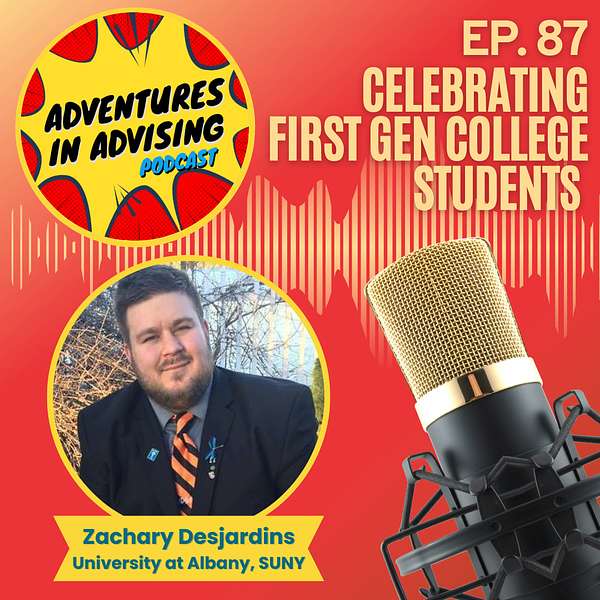
In Ep. 87, we're observing First-Generation College Celebration in November! We chat with Zachary Desjardins with University at Albany. As a proud first-generation college graduate, Zach shares his personal and professional experience tackling the institutional and psychological barriers that exist for first-generation college students and how to better serve our students.
Follow the podcast on your favorite podcast platform!
The Instagram, and Facebook handle for the podcast is @AdvisingPodcast
Also, subscribe to our Adventures in Advising YouTube Channel!
Connect with Matt and Ryan on LinkedIn.
Matt Markin
Hey, this is Matt Markin and welcome back to another I think fantastic episode of the Adventures and Advising podcast. We are at episode 87. And on today's episode we're talking first generation college students. Why? Well because it's November and November 8 is a national first generation college celebration. And we have special guests today. Zachary Desjardins. Zach is a proud first generation college graduate. His passion for higher education stemmed from his time as a charismatic student leader, where he received a BS in social work, he went on to earn an MSc in Student Affairs Administration and a Master's of Public Administration. Currently, he's Zachary's role is a university academic advisor for the Academic Support Center. He is a dedicated professional who isn't afraid of tackling the institutional and psychological barriers that exist for first generation college students. He previously served on U Albany's first generation college student success task force, and currently is an active member of Nevada's first generation student advising community steering committee. Zach's ultimate aspiration is to become an inclusive and collaborative leader in higher education policy and administration. They firmly believe that with the right paws positive policy and infrastructures reforms, higher education can be a place that not only improves first generation college students lives, but their futures as well. Zach, welcome to the podcast.
Zachary Desjardins
Thank you, man. We're really glad to be here. This is really exciting.
Matt Markin
And before we start, like with our first user, our first question is about your background and your path in higher ed, we both have a certain person we know. And he's a good friend of mine, friend of the podcast, prior guests on the podcast, and that is Michael Geroux, or as some of us call him, Mike G. So I wanted to kind of start actually with this question is, who is Mike G to you?
Zachary Desjardins
Mike G. is actually my direct supervisor, also known as mentor, because Mike will often mentor me even outside their position, just to kind of help me understand the ins and outs of higher education, how to navigate the bureaucracy, or even just someone I can just lean on when I need to talk to you about some issues I'm experiencing in my professional career. So go, Mike, love Mike.
Matt Markin
So I had told Mike that out that we were going to be recording together for the podcast. And as I said, Tell me about Zach. And so this is what he wrote back to me said Zach is one of the most passionate and enthusiastic higher ed professionals I have had the pleasure of working with. He has a special gift when it comes to making students feel welcome, seen and heard as he learns about their individual stories, especially those who are first generation. His compassion and dedication runs deep with supporting both his students and his colleagues as they work to achieve their desired goals. Zach's approach to academic advising is purposeful and always centered around, remember there why. So Zach, tell us about you. What's been your journey in higher ed?
Zachary Desjardins
Yeah. So I would say my journey of higher education is actually a very unique one. And it's kind of a long story, but I'll try to keep it brief as much as possible. But basically, I would say the first one was actually ever exposed to higher education, and understand what higher education was truly all about. And everything was when I was in ninth grade. I remember sitting in a classroom, I remember my English teacher, Mrs. Fall, so shout out to Mr. Fall if you're watching this, I miss you very much. And he was a big part of my life, especially with growing up in adolescence in the small town of cheesy New York. And she said, we had a guest speaker coming to speak to class and her name was Julie Kuhn. Once again, shout out to Julie Kuhn, Julie, who was actually an upper bound counselor. And I remember she was telling us about this program that she worked for called Upward Bound. And it was at SUNY Plattsburgh, which was 20 minutes from where I actually grew up in Chazy. And she says, Hey, we have this problem called upper bound is for people who are first in their family to go to college, or people come from low income backgrounds, or students may have learning disabilities, invisible or visible disabilities, as well. And Julis is basically what we have as a summer program where you're going to take some college classes, or even classes are just going to prepare you for the following year on school, and all that kind of stuff. We also get to go on trips. She even showed us this awesome video of like, things that they did in a previous summer, which I thought was so cool. And I was like, dang, that sounds so cool. Like, I would love to be a part of that. I mean, it must cost a billion dollars, because that's, ah, I didn't know how much it really was. And then Julie's demodulate said that her famous catchphrase was, guess how much program cost? And I everyone gets an I think, I guess, like maybe $250 or 300 at the time. And she's like, well, joke's on all of you. It's actually three. And I was like, what? That's crazy. I remember I came home and I rushed to tell my parents like, mom, dad, hey, this is really kind of cool. There's this phone called upper bound and all this kind of stuff on we should really kind of check it out and everything um, and I would love to do that. I think we're kind of really helped me because I'm at that time I always really wanted to go to college. I had some big aspirations, and everything and I was like, do I really want to go to college? I think this can help prepare me for that. It's my parents fill out the paperwork. And I remember the day I think it was like sometime in like, April, I believe we April, May I got a letter in the mail, if the gratulations you've been accepted the upper bound program. And I remember just being so enthusiastic, I was so excited. Those times when I was an Upward Bound as a student, were some of the best summers of my life. Even to this day, I met some of my closest friends possible. One of my roommate, current roommates, actually fun fact, we were both obviously, roommates and upper bound, and we actually were roommates, all the years of upper bound together, this person is also going to become my wedding party someday when they get married, because we're like that close. I mean, he would show people, a lot of people I made friends with in high school. But because of that, he said, that program really prepared me for exposure to higher education. Then I remember I graduated, and I just really big dream, I really wanted to go to this one school, and I really put all my eggs in one basket. And I remember the day right before I was actually supposed to leave to actually go to the college itself to move in. My dad just says, hey, everything's good, right? Like, you know, you don't have to worry about anything. I'm like, you know, I think I was finding my dancing. You may just want to call just to make sure things are good before you move in, because I was planning to go to school, near the Rochester area of Rochester, New York, and everything. And so I called them. And they told me like, Hey, I just wanted to let you know, we were trying to recover your financial aid, because I guess there must have been an error that exists. And unfortunately, you owe the college around $6,000. And I went in I was at what six? I'd even like to me like that was a ton of money. And it still is even to this day. And I told myself when I was like, Oh, well, what can I do? Can I do like a payment plan as soon as I can do anything, but we need that money within the first two weeks of school. And I come from a very low income family, I both my parents worked extremely hard on the follow go away, my dad didn't losing his job. My mom always has worked as a direct support professional and Toyota Alexa, she didn't really make a lot of money either. And I remember it was like, Well, can I do this? Or can I do that and everything. And I tried to talk about the different plans and long story short, it just didn't end up working out. During that time to be completely vulnerable and honest about the situation. I ended up going through a very big depression. I felt like I wasted my time and Upward Bound. Because upper bound prepares us to go to college, and I was the one few person who just didn't go. So I felt guilty because I was busy taking advantage of this huge program that really helped support the students. And I'm like this could have went to someone else who could have went to college. So I remember I told my dad and my dad's like, Well, hey, doesn't his dream dies doesn't mean the dream just ends. Just we just we postponed. And I was like, no, but Dad, it's not going to happen. And I was in that mindset. And I remember the Somebody says, Well, hey, you gotta pick yourself back up. So do something, you know, at least do something with your time. So I applied for a job at Sam's Club, where I used to work in the meat department, you know, as a meat wrapper. So I used to wrap the meat stop the shells, you know, I mean, I say every once awhile cut me because Oh, my coworker to teach manager how to cut the meat in the offseason that was kind of cool. And everything. And I ended up working that job for a whole year, year and a half. I remember Brian post, once again, shout out to Brian post, the director of Upward Bound has been trying to get in touch me, because I think what he did was he wanted to make sure we all went to college. But he heard that I didn't go to college, because it's a very small town. Placer is a very small area. So it's kind of easy to figure out people and what people are doing. And so Brian has been trying to get in touch me and I kept on ignoring his calls. Because I felt like I felt ashamed. I felt horrible. You know, I mean, I didn't want to talk to him because I didn't want to miss him. And I couldn't go to college. And I remember one day he actually went to Sam's Club itself. He was actually going shopping, and he bumped into me. And he goes, Hey, Zack, what are you doing here? And I was like, Well, I'm actually here because I'm actually working. And he's like, Oh, weren't you supposed to be in college? I think he knew it was kind of like a little bit question. So you know, and I was like, yeah, that didn't work out. And I really, and Brian's like, well here, call my number. Don't feel shame, don't feel guilt. Let's talk. And I remember literally, so it's gonna leave on Brian on my only day off. It was on I once it was like a Tuesday or Wednesday. I called Brian. You know, I was in Plattsburgh. And Brian actually brought me to have this little like a little sub restaurant that's famous in our town called Zooks. Success. And I remember having a Zookz sub, and then Brian was like, Hey, you could still go to college, there's still possibility you only don't let the dream die very echoing very similar to what my dad told me. Sometimes, you know, life is not so linear. I think sometimes we kind of go about things we think that oh, one plus one has to equal to you me, but that's not always the case. With life. There's always this hidden variables. So why don't we go back to the office? Think about where you're going to apply to you. You don't I mean, you have an idea of what you wanted to do. And at that time, I actually wanted to be going to actually like one fact actually, it was more like an a ministry work because um, Christianity was a huge part of my life at that time. And so it was a you know, I actually kind of want to go more into like, coming to history teacher because I was always the sub area I always wanted to go into as well. I'm like, I want to be a history professor, things like that. So Brian's like, do you know SUNY Plattsburgh has a great program, and I was like they do. But to me SUNY Plattsburgh was always the type of school that my mom was used to work at SUNY Plattsburgh, and basically the subsection of it, where she worked at 30, Janelle DeSimone, where she worked with people who had Alzheimer's or other developmental disabilities, and so suited for was always like my home, even in SUNY Plattsburgh upper bound. So I rolled those halls ever since I was a young child, and I just thought was stupid later, but I'm like, I'll apply for this. Long story short, I worked for Brian and I would Julie, my previous counselor, placing your password and I got in. And ever since then I would say things have gone up, I basically started his study in history. And then I remember, things got a little more difficult, you know, so I did talking to my trio advisor, because at that point, they actually retrieved Student Support Services, which is another Trooper, I'm just like upper bound, but I help students while you're in college. And so I connect with my trio counselor, and I were just talking to her about how difficult things were. And I told her, I was falling out of love with the love of history that I once had. And I said, Honestly, and I feel like this education system is just flawed. Why is it that like people like me have to work twice as hard? Or why do I always feel like I'm so far behind you? But no, I'm no, I'm two steps ahead. If you really articulated me with the freshman in college student was all about that experience and was actually felt like she said, rather than look at the negatives, look at it more as a positively This is a source of strength for you. And so because of all those great things and all those interventions, I was like, Well, what do I do? How do I change it? She's like, you know, there's a program like that where you can work in higher education, you can make an impact on students lives, as like, what's that? And that's when we all have the krenzel lightbulb moment is through first higher education around. And I said, Well, how do you do that to that? Well, we actually have a program here on our campus, you should reach out to the person whose chair that program and figure out what kind of things they would like to see. And that's what I did. So once my sophomore year happened, I reached out to her and I realized that, hey, I really want to do the major of Social Work. That was really important to me. So I end up doing the major social work. And then I started looking at grad proach at the time, and like you said, I'm sure you're gonna ask later questions about my more experienced wine was in undergrad itself because it relates to some things I got involved with. But because of that I had a long promoterless journey throughout my undergrad and I had a lot of pain, but also a lot of joy. You know, I got involved a lot of different things, I became a brother, I find new delta national fraternity. So that was amazing. But I also got to surround myself with a lot of like minded people to kind of help propel me forward. And they said that kind of became my entrance into higher education. As I understand what it was like to not have a college degree. What's really true made me appreciate what it was like to actually have one. And then when I went to Binghamton, like I said, Well, you mentioned before and got the dual master's program in public administration, as well as in Student Affairs Administration, I ended up getting my first job at Corning Community College for TRiO Student Support Services where I work specifically with first generation college students, and students who are learning or physical disabilities. And I really love that. And that was amazing. Even throughout my time in graduate school, I also worked as an RD or what would they call the ARC so it's basically a part of time grad student, I have sought a supervisor who was an RD things like di and all that trips that really just made me really appreciate higher education, and the gift of a college education and actually truly having so many different individuals and what people do with that gift moving forward and truly inspire me, which then now lead me to my job Have you all been in because unfortunately, a job at Corning Community College that got my last year of grad school COVID hit. And so a lot things happen. Budget cuts happen, we actually had the grant did not get renewed for my position. So I end up finding finding our job and thankfully you opening was hired to a university academic advisor with are trying to implement a new Four Year Advising models. So it was more of a holistic advising approach. And thankfully, they offered the job to me and along with I want to say eight or nine other people. And so we call ourselves a COVID squad because we all hybrid all I want. And since I've been to you already, and I said that's when I met Mike G. as my supervisor, and the rest is history, you know?
Matt Markin
it's one of those things, too, you know, life always has the ups and downs, but it seems like at parts where you're kind of, you know, maybe down with things that are happening, like you didn't necessarily seek out so they just kind of happened just show up and then kind of plant the seed and say, Hey, do you know about this program, this program that then led you to these opportunities and taking advantage of those which I think is fantastic. And then just kind of Yeah, kind of keep that positive spirit throughout the whole thing. And a lot of it kind of starts with was a Julie that kind of mentioned the the Upward Bound program and kind of how things kind of came about afterwards. So I think that's a fantastic story. And you're able to share that not only on this podcast, but also with the students that that you meet with. So kind of leading into that, you know, first gen students, what would be your definition of a first generation college student because it seems like it's slightly different depending on institution that that you're at.
Zachary Desjardins
Yeah, no, that's a great question. And I agree with you, I think the very definition of our heritage and culture is very difficult. And it's something that landscape I feel as a profession, I think we should try to address. But that's a whole nother conversation aside, but I do find it frustration college as a student who's neither parents have earned at least a bachelor's degree regardless of other siblings status. So I have two older siblings, two older sisters, who I've loved very dearly. You know, neither of them actually got a college degree, except for my one of my older sisters, Bernie, she actually didn't get a college degree after I got mine, that she was inspired by my work going back to college, that she decided to continue that along as well. So at that point, even if he she got to be for me, I she would still be appreciated. I would certainly appreciate it. Because you don't want to create some earn at least a bachelor's degree.
Matt Markin
We were mentioning earlier, we started the recording that this is going to be going out on the first week of November or first full week in November. So you have November 8 being national first generation college celebration. What can you tell us about that? And is that something that UAlbany also celebrates?
Zachary Desjardins
Yeah, so this is actually a huge initiative that usually happens on a lot of other campuses. I can see every single college does this because obviously, you really need to look into that as well. But basically, it's a date that's on like November eighth, you know, it happens every single year, they call it National College Student celebration day. I know a lot because also a lot of times when the province was part of like when it came to like trio, and things like that would have happened. And it would always do an event that happened on this day. I know, we see you already, we basically started with the push of actually supporting frustration students on institutional level. And so because of that on lately, I would say we had a whole full week of events last year to really kick it off. It's the first time we've ever did something on that day, even that week, which was fired apart when I was actually in the first session called soon taskforce. And so that was really kind of cool. And um, this year right now, I can't really tell if there's anything much really going on. I know there's some offices trying to work on things I know currently right now, because I'm not one of those people. I'm a self motivator. So even right now I've already partnered up with them. Her name is Princess Otis who works in the sea step and project excel program, which are two programs that actually work with a lot of frustration college students themselves, and actually worked with her along with a newly found group on the first version called Student Union. That was actually I have to actually start up at UAlbany, we're actually collaborating on an event called leaving our first gen mark. And basically, what we're doing there is we're actually having this time where first generation college students kind of showcase their artistic ability of Will there be through music, through a poetry through a photograph, through a painting, a dramatic scene, you know, things like that, we're gonna have people do that, and then when we're having people do is trace their hand, and when they trace their hand, they're going to color in their hand, or they're gonna put their name in the middle, and in the middle of the poster board is gonna have something along the lines of leaving my first gen market you already. And what we're going to do is we're gonna hang that poster board up for the rest of the month of November, it's at our campus center. And so in this circumstance, all firsthand. So to see it, I'm gonna see that everyone's handprints and everything all on the poster board, they also see also showcase that wonderful talent exists within this amazing community here at UAlbany. So that's one thing I'm doing on the side. But um, we said, I think the university is also playing to other things as well. And I'm really hoping they do but for right now, that's why I can tell you as right now, that's what's actually in the books.
Matt Markin
I think it's a very creative concept. And I hope you get a lot of students that participate in now, in your bio, you it's mentioned that there can be institutional and psychological barriers that exist for first generation college students. Talk to us more about that. And you know, can you give us some examples?
Zachary Desjardins
Yeah, so one thing I would say when it comes to more of the institutional barriers, I think the hidden curriculum is huge. Oftentimes, when I talk to students, they always look to their peers, because that's the only time we can really gauge it. A lot of my freshman college friends feel like they're so far behind, or they're always two steps behind always. And I think that's because, you know, a lot of times when you have potential as you go to college, you kind of want to get how things operate, and how things work grants gonna give you a rough idea. Obviously, things have changed even within the past year, the past 10 years, 15-20 years, even within the last month, to be honest and higher education. But because of that, oftentimes, the students they look at their peers are like, well, they already get to go to financial aid. They already know how to understand their financial aid bill, why don't I understand my financial bill? Is there something wrong with me? You and I love the quote just one person. When I actually have a presentation we actually talked about fishing for machu Maga which goes into another issue is family achievement guilt when it comes to more of the psychological barriers, but one woman said, it's crazy how well we define first in college students, we always had to basically a student who's failing does not have a bachelor, at least a bachelor's degree with the parents. And as they're already, they're already operating at a deficit. And I that really hit me really hard. I was like, Wow, that's crazy to think about your derogatorily students deficits or anything, when it comes to institutional barriers, you also have faculty who have an old, old school way of doing things and may not realize they're doing this on our implicit biases. When they kind of come out, we always look at suits, we're deficit approach. And we'll say, Oh, these suits need our help, or there's something wrong with them. But there's nothing wrong with these people. It's a system that's put in play, that's been difficult for them, you see that play that's not in to their advantage. So I think even just I'm becoming more aware, so I always tell people is, even my coworkers, if you see the hidden curriculum going, don't make it hidden, make it known curriculum, don't assume a first version called student knows everything that's going on institution are also don'ts. And they don't know things are going on institution, because some of them are very well aware, they know what they're doing. And they're very intentional with what they do. The beauties of a frustrating college students is they're not a monolith. So they come from a lot of different backgrounds that come from all different ways of life, different cultural, ethnic backgrounds, different abilities, different genders, sexual orientations, all that types of stuff. And so we shouldn't be a monolith either, as a professional and working with these students, you know, we should have find one way of doing things we need to be intentional, impactful, you know, connect with the students be individualized, when we work through students really get to know our students in tug of war on an individual basis, is going to figure out how can we support them through their individual needs, because that's the best way we can best support this population, because they don't all look the same.
Matt Markin
Because, you know, because I remember we were chatting prior to the recording and I think that's kind of a lot of it ties into, as you had mentioned that, especially when relating to student conversations that like advisors, or even as students, like we don't see, as you know, we don't see things as they are, but as we are, and, and then, you had also mentioned that like, as advisors, or advisor professionals really consider how concerning that might be to a student, when we tell them like, oh, you know, go to this department, and then we kind of just like, let them roam off. And hopefully they get there. And they may not know where that department is or what to ask, or who could be a contact person for that now, and I'm sure to like always comes out to time constraints as well with our appointments. But for you, it's kind of like, we really should go that extra mile to assist our students no matter who they are, and ensure that they know what to do based off what information we give them.
Zachary Desjardins
Exactly. And I can do that across all your students. Whether the students are first generation college student or not all your students when you refer to English or social jumpsuit, say go to financial aid. Because he's your first I can see right now, but go to Matt Markin and financially. And this is what the process is going to look like, ask him these types of questions. Because the problem is they also do you also want to develop a like a normalcy amongst humans, because then you don't have to worry about being super intentional and all your practice or feel like you forgot something when you're working with a frustrating conflict, is it your natural practice to dismantle the hidden curriculum, you know, because a hidden curriculum was created, because there's a lot of implicit biases. Here, there's lots of implicit systems or processes that exist in the college education system. So if you make it well known, it doesn't matter who you work with the cool thing about Bucha frustrating cultures is the practice you do with first generation college students, you can apply that to any student population, and they're only going to benefit from that service. So if you wouldn't attribute practice that even with your non personal accomplishments, it's only going to impact your first year in college when you work with them as well. So that's why I say refer them to people because the campus itself the hidden curriculum is large, that keep us feel small, make it feel like a small thing gives you always a huge college. So actually, people make campus feel small but connected individuals connected with the process, let give them that cheat sheet, hey, this isn't the kind of questions they're gonna ask you. These are the kinds of things are going to be looking for you? Do you know these questions? Do you want to brainstorm a do if people hate this, but I love role playing? You know, sometimes I'll even roleplay with my students about what the conversation is going to be like, presented, they don't know some it's okay to then we can figure that out now. So you don't have to feel shameful when you do connect with that service and don't know that answer.
Matt Markin
I mean, you know, based off your experience, too, like for you growing up and things that you've mentioned already and, you know, maybe as advisors working with students is, you know, you've mentioned that the shame and the guilt part. And as much as you know, we can try to connect with our students, they might still continue to have that shame and guilt. Any advice for advisors when they are working with whether it's first gen students or anyone that is experiencing that shame and guilt?
Zachary Desjardins
I always recommend people do is validate it. It's a very real feeling. I think the hard part is, is that when we work through people who have the shame and guilt insufficiency, it was a frustrating college students is that you're not going to cure it. You know, I mean, it's not going to come overnight. You know, it's an endless struggle. What really helped me out a lot, when I was an undergrad with somebody actually bother us. That's a great feeling. It's okay to have that feeling like, Thank you for actually addressing that. Thank you for like, talking about that. And let's unpack this, what's going on in your life. And at that point, I remember telling my story, I wish I tell us in my presentation about the story of my dad, when my dad got really sick. And I remember even having a conversation with my mom being like, I don't know what's gonna be life without having you having a father. I don't know what's gonna life without me having a husband, you I felt so guilty, because while I was going to college, I was an RA, I got to live in a place in a dorm, you know, in a residence hall. But then what ended up happening is I ended up having my parents were calling me saying, Hey, we may actually end up losing the house because of finances. How is it fair that like, I got to live on a place on campus, but my family was struggling to find a place where they could be, I had a full meal, I could go to I could go to the dowel, swipe my meal swipe, but my parents didn't know where the next meal was gonna come from our other than afford food, you know, things like that. And so that's a very big reality. So I think just valuing that concern and knowing that you're not going to probably fix it, which kind of really sucks especially to work in in higher education profession. We're always here because we want to help students, we want to fix some of their problems. And it's horrible to say, but you're not here to fix anything. It's up to the owners of the student to make sense of their guilt, make sense of their shame, because they might not come up to you and tell you, Hey, I feel shameful. I feel guilty. Because I didn't do that. When it came to my advisor at the time. My true advisor when I was experiencing that, they started saying, Oh, wait, do you feel guilty? Like they asked you, I feel like, well, do you feel guilty because all these things are happening. And I was like, wow, that's a great way to put it in. I didn't realize I was going through that until Lily, I came up with this presentation I did for NACADA. They realize actually, this is actually a common occurrence actually a law student face. Even my job currently right now and shout out to Mike G because we mentioned them before. I remember my second week of my job, my parents were having issues with their house. And I remember talking to Mike and we're like, Mike, I can't be here, I have to go home, I'm asked to leave my job, thanks for the job. And I really appreciate this awesome, I gotta go home, I gotta find Jeff closer to home, because my family is struggling. And I feel guilty of beating you all because I make more money than both my parents did combined. And I'm like, I can't I can't do this, the I have to go home. And Mike was like, This is exactly why you're here. This is why we want you in this office, this is your value, this is what you bring to our office because we know you, you can leave this out of that fine. But I want to know what you're going through right now, it's going to be a huge impact on the story of the students that you talk with, you're going to be able to connect with them on such a deeper level that some other person can't, because you're going through this right now. And you're also not only making yourself better as an advisor, but you're making our staff better by you just being here, give telling me the story that go into what you're going through. Because you will bring a value to not only your role, but also to our institution. And because of that little conversation, we also have a lot of personal things, like actually grounded me and I was like, you know, he was right. And I'm so glad I stayed here, you because now I got to make an impact on all these students. If it wasn't for like actually taking time out of his busy day, being my supervisor, you're going to really connect with me and really helped me understand and validate that guilt. I don't know if I would even be here talking to you right now. That's that's the beauty of it, you and I wouldn't even find my niche within our office as well work with frustrating college students. So to answer your question, I think just validate the guilt, be there with them, talk to them, articulate the college process, just give them the extra mile, one of my co workers, John Martinez, who I love very much as well, which as you can tell I give a lot left. I apologize. But he always says the greatest gift we can give our students is our time. And that's a privilege. It's a clue that these students that were able to actually have that much of an impact on the students lives. So we need to take this privilege of giving them that time and use it to our best of our ability and to make an impact in students. So use that time to really sit with them. Talk with them, connect with them after follow up. Yeah, hey, I know you've talked to worry about this. How are things going? Like you said we've mentioned before just make campus feel smaller and make them see and feel seen, heard and valued. And let them know that they are a valued member of our institution, our profession, all that type stuff, because they are and they truly do every single day. And they remind me like Mike, you said before Mike reminds me of my wife, my students ever Sunday remind me of my wife and I love to do that on a daily basis. Like I wouldn't be here if it wasn't for all of you here coming to my house and talking to me about these things.
Matt Markin
Never apologize for giving a shout outs. I mean we're we're at based off other people that have mentored us or have been part of our lives that have helped us that's you know, even just one little quote that just led us on a different trajectory. So you know, we got to give people their their kudos their flowers, so yeah, never apologize for that. You know, you were mentioning the your presentation for NACADA. So that one was a co presentation I think it did so that was called breaking barriers and powering resilience overcoming family achievement, guilt and first generation college students. What was your experience like and how do you feel things went with your presentation?
Zachary Desjardins
I think I think it was amazing and shout out once again, Shannon Sousa, I see you my co presenter, she was amazing. We did a library work together, I would say, since we went, she gonna call it like a joke around and call our tour. So I love music. So I felt like, we were like a band and going on tour, because we know that present for NACADA. But we also present a lot of smaller colleges as well, you know, because our presentation in the kind of region one, we have a lot of people reach out to us asking us, Hey, you actually present for our college, we actually would love to hear that. So we're actually bringing this message to the masses, which was actually kind of cool in the research that we stumbled across. And we even brought that researcher to all these other people who work with for sure in college and let them know, like, hey, you know, this research actually exist. And so that presentation was so cathartic, you know, and I think for me, it really kind of helped me actually make some closure and some of the films that I actually had, and also helping me make sense of a lot of those things as well. And just rejuvenated my love of this profession of higher education, you know, rejuvenated based on my experience, and that so cool is that we have so many great people who are working in the world are doing the great work inside the professions of higher education and doing amazing work. And not only that, but also making such a huge impact on our students. It also makes us realize how human we are as well. Like we I've actually had people personally messaged me on the NACADA app or even through my LinkedIn, you'll be like, Hey, I finally felt heard and seen for somebody I've been experiencing that he just never knew when it actually happened. And so things like that were just incredible. I mean, another one as well, as I remember, even when we presented Region One, we actually had this one advisor who was talking about how he was working with a student, and going through this guilt and all this kind of stuff. And it was so magical. And the person who was we're talking about was also in that audience as well. And he did not realize that and that's something we didn't even show before. And so it's been such like a magical, beautiful moment, and also has been given so many professionals who are doing this great work that affirmation, I know you're doing the great work, keep it up. But it also gives people who may not actually think about this as a concept to also be like you want maybe I should start talking to my students have deeper conversations and like, actually talk to my friends who are experiencing this. And I certainly didn't take the time to actually make a word for this. So that's also been really great as well. But he said, it literally has just been beautiful. And I've even tried to be even more intentional. Now that I know this research exists to even talk to my students more now more intentional conversation about this. I also unfortunately teach a zero credit first gen seminar class, which uncultured seminar, are you opening until I've even incorporated this whole lesson into my curriculum?
Matt Markin
Well, let's talk about the class because you just mentioned that it's zero units. So is it a requirement? Or how do you get students to kind of join into to take this class?
Zachary Desjardins
So usually what we do is, we will have as advisors when they go through to file, we make schedules for students here at UAlbany. So we'll go through we have a batch of students we go through, we will look through their file, and then what we'll do is we'll look through it, make your schedule, and then we'll send it out to the student. And if they want to make changes, then we obviously will make a few changes, things like that based on their needs. So basically, what we do is we kind of leave it up to the advisor itself, gonna go through their file, because when they look through their SUNY application, we'll say, your parents love education. So they'll look through and if they actually have the definition that I just mentioned earlier in this present on podcast, that they'll go through, like, Okay, this is a first time college student do I think they would benefit from them, I'll put them in the class. Okay. And so basically, advisor was replaced those people in the class, we used to also teach in the spring semester where students will opt into the class. And so usually that will happen by advisors talking to students about it or not, I will also talk to them. So my students about it, I'll even send an email to all first gen students that I've worked with, in the past or present to have them enroll in this class. But this spring, we're actually not going to do it in spring, just because we have some unique plans that we're gonna do for a fall. So I won't mention all those because I'm still trying to work all that kind of stuff out. But basically, we just have people placed them in the class. And then I even tell the students that this is your plat class, you don't have to be here. But if you really want to actually engage in this, I can guarantee you, you're going to take away something beautiful in this class. And it's only for eight weeks, your intro doesn't get in most of the semester, it's only for around an hour. And I tell students, if you want to show up, you're going to take away something or you may not realize you're going to take away something until the very end. And then that's when things change. And so because of that we go through different lesson plans. I think what we have talked about financial aid, and not only do we go through her financial aid bill, but we also talked about some deeper things like if you can't afford college, what's that? Like? We also go through the social social environment itself, like how do you get involved on campus? How will the importance of understand your firsthand identity and what that truly means? Do you understand the college experience is a very experienced, it's not just a one and done. Everyone has varying difficulties, or even achievement to the accomplishment or in college, things like that. So we've talked about those types of things. And now I've said before, I'm trying to bring in the achievement guilt, because it actually brought about one of my students what actually is why did the presentation was because we were talking about well being in the courts of mental health, because mental health is a huge passion of mine as well. My father has bipolar, and depression. So me trying to bring people out to the masses understand what on depression, mental health things that are super important. And everything about well being in this on dismantling the stigmas that exists when it comes to mental health. And I remember I had one of my students who actually mentioned me in the class was like, Hey, I feel like I have to sacrifice part of myself just to succeed in college. But then when I go back home, I have to sacrifice what I learned in college, just to fit in with my family. Then when I come back to college, I just feel like I'm a walking shell of a person, because I don't know who I am anymore. Is that normal? And how do you expect to retain someone who doesn't even know who they are. And then I remember they told me that in my class, when we're just a well being and how things people are doing. And that hit me like a truck, Matt. I was just like, Oh my gosh. And I remember I even got a little teary eyed because I was going through the same thing when I was an undergrad. They didn't know this. But like, when I was going through that I was well, I was even explained to them my professional career as well. And I did tell them that and I went up to the student I wasn't you know, it doesn't go away. And it's not going but it's I'm always reminded of instead of running away from it, like I used to in the past, I made sense of it, either to empower me and I tell it to all my students is like, use your first hand story to empower you. Moving forward, you're a pioneer, you are a trailblazer, you're a leader, all these types of things. But that's a long story short, to tell you why the United exists and why people read through the hotspot, the great things that actually exist within the United has been truly a beautiful, beautiful thing for me.
Matt Markin
I'm interested in another presentation that you did, I think this was few years ago. So it's like 2019. So this is thinking around the time that you were an assistant residential coordinator. But you did one called making the invisible visible working with first gen college students in the residence hall. Yes, I was interested to know about kind of the backstory behind that one.
Zachary Desjardins
Wow. That's a That's a deep cut. Let's Yeah. So basically, when I was waiting, we did as for Residence Life on the beach, and a call for proposals to actually present for RAs, and stuff on how to work with certain students, or certain student groups, and a lot of my RAs who actually supervise new as a first gen like, Zach, I think you should do a presentation on first gen, because a lot of the first gen just aren't coming to our programs, they're not getting involved in campus community, they don't really feel like a sense of belonging. So okay, maybe if my RAs are struggling how to engage with first gen students, I'm sure this is something I'm thinking through University's campus. That's a huge issue as well. So I literally submitted a proposal for RA training, which was titled that same exact presentation that you just talked about. So one thing I would say is what I did was I kind of just talked about how do we actually make these fixtures and helps them feel heard, you know, how do we make them feel seen in the residence halls, because oftentimes, RAs would just go away, oh, I advertise my program, but they didn't get they didn't get it, or they didn't understand things. So I basically tried to give them step by stuffs presentation on actually how to engage with the students like build the connection and talk to them, what's going to dismantle the hidden curriculum, really, they may not realize that RAS do programming every single semester, they might not realize that they can go to that array to talk to them about issues that they're experiencing about college as a whole, their sense of belonging, they probably don't assume because you haven't specifically invited them or talk to them. So they know they can actually attend that meeting that you're trying to have or that program you're doing. So it kind of just gave tips for a lot of other residents, residents systems, and also resident directors who are in attendance, how do you actually work with a first generation college student population, when it actually come through the residence hall itself?
Matt Markin
I feel that can be like a rolling presentation, you can do various goals and conferences. So if you have a baby does that one off too and and keep doing that one. Other things that you've been part of, you know, you talked a little bit about being part of you Albany's first gen College Student Success Task Force, you're currently on the Congress, First Gen. AC steering committee, what's been your experience, like on the steering committee? And you know, what are some of the goals that the steering committee is looking to accomplish? Yeah,
Zachary Desjardins
So my experience has been an absolutely incredible I think it's so awesome to see other first gen, but now there may be professionals who want you to work private first generation graduates, but also people who work directly with first gen students. So who they want me as as I do that intertwined to my job or profession and stuff, but I also see all types of students going I just have a special affinity for the group because that's the group that I'm a part of, but even just kind of getting their feedback on what kind of trends are seeing and their experiences with their institutions are doing when it comes to supporting for sure and students for me like I said, supporting this population has always been UAlbany, but now we're starting to put that little bit more at the forefront than we had in the past. So kind of getting their feedback their mentorship you know, he's also been incredible on some of the golfing even tried to do this semester, while this whole year I would say is put out some really great progress I mean, like, don't worry so much about the quality of your programs, but the quality of your programs. And so because I felt like we've actually been having a really high attendance, so a lot of events that we've been holding, like, you know, rather than doing eight things half assed, or very, not really planned out, I really thought about, let's actually be really intentional with our program. And let's also get people who are power sharing committee who actually have a great skill set, and let's bring them in to lead those presentations, and have them talk about those types of things. And so that's one of the things we've been doing a lot when it comes to things like that. We've also been trying to build more on our community as well, actually, because that's what I tell people, as we're advising community, let's actually be a community, you and let's support one another, what show up when someone's presenting the kind of comments which you actually had to a lot of other great people in our community, I'm actually present for NACADA. So do we show up to their programs, send them messages, like, Hey, I know you're presenting today. Good luck, you got this, you things that let people know that they're valued, and they're appreciated. That's another thing we've also been trying to do too. And we're now we're always trying to get the word out there. And I know that our community actually exists in their advising committee that our steering committee also exists. So if you want to get involved, that's a way you can also get involved as well. But I'd say I be more intentional with our programming, but also be more intentional with our communications to one another, and actually, don't just meet up once a month for a steering committee. Let's be outside as well. You know, we always ever like I had one of people who was actually on the steering committee, his name is Moises, you know, I was shocked by my voices, the legend, you know, and he always joke around about that, you know, and he always laughs. But Healy reached out to me, he was like, Hey, I'm trying to engage my first generation college students who I work with in a PowerPoint. And he's like, I need this player, because there's that players like super engaging high energy, things that let me know, some tips for a PowerPoint. And I literally sent him a message saying, Hey, this is what I do in my presentations, you know, I didn't means you know, I make jokes. You know, I also try to be more engaged, if I'm excited about it, then other people gonna make that bet as well. So even just little things like that, talking to one or even outside the meetings to kind of boot developmentally as us as people, but us as professionals as well, because that's what it's all about, because wonderful as the networking opportunities we have. So let's do more of those opportunities to connect with one another, not your identity of being a first generation college graduate, but also through the work that we do as well.
Matt Markin
I think it's a great way to end the more advising related questions of this interview. But as we wrap up, I asked Mike G to give me some questions I could ask Zack to end this interview, that are non advising related. So his first question that you just ask Zach is where did the nickname Yogi come from?
Zachary Desjardins
Okay, so actually, so actually, it's like a two fold thing. So, one is when I actually worked at Sam's Club, people were like, You're a big guy. So I'm like six foot two. You know, I'm built like a linebacker from the football for the NFL. But everyone just says I'm just a bundle of joy and optimism. And people would joke around call me optimist prime. That's transformers reference call you locally nerds like myself, and basically having to come back but you're, you're like a bear. You know, you've got a beard, You're a big guy, all this kind of stuff. We should call you Yogi. Instead, I kind of worked at Sam's Club for a little bit. And then eventually when end up happening was when I actually worked at SUNY Plattsburgh in my undergrad, I left Sam's Club and actually decided take a plunge once I decided want to shoot in the fairies and actually became an orientation leader. And I went I'm humanoids. Actually, that was my first first introduction. Like, this is how higher ed this is actually working for the college is what it's all about. Things like that. And I remember, I think it was the third week, second or third week, I actually had a bunch of shows were like, wow, you're just always laughing. You're always smiling you I mean, you're just like, really happy to be here. You know, you're high energy. You remind me of a bear. And I was like, Oh, here we go again. And you're a big guy. You're You're just like a giant teddy bear. And I was like, well, whatever you do, just don't call me poohbear So fun fact, my mom loves Winnie the Pooh. And she was like, don't call me poohbear Because it reminds me of my mom, you know, I mean, and you know, you're not poohbear You're more like a Yogi Bear. And at that time when I became an almond or occasionally I was a sophomore. So you think about the incoming class as freshmen first year students, so they got it, sir. And it just called me Yogi like, hey, Yogi, what's up? Yo, yo, what's up guys? So eventually, people thought that was actually my real name. It actually wasn't exactly so because I was a freshman class. Then the year after that, those people start calling me yogi. And so became this like giant like cult following of my name, BC, nicknamed as Yogi. So eventually everyone started calling me that Interviewer So you should start introducing yourself as you're getting became like more of like a tear, a term of endearment. So even my art my students were when I was an RA, they're all with us at yoga Yogi's my RA. I'm like, Oh, my name is Zack like no. So they would take off Zach every single time on my door and say put Yogi instead, then I will take the yogi on my door. It just became this cult following people just call them yoga. And eventually, people thought that was actually my name. And it just kind of transpired. Why I went to grad school, because all my grad friends were like, Oh my god. Second yogi, so much of a cooler name, because I feel like yogi, so many residents start calling me not because they started calling me that. So my alrea side, that was my name, because that's what my RG and my supervisors would call me. You know, and it just it kind of in my lane kind of got lost. It wasn't sack anymore. It was yogi.
Matt Markin
I can imagine and if it ever happened, then people getting confused. And then once someone says, Zach, can you answer to Zach and like, Wait, that's not his name?
Zachary Desjardins
Exactly. Yeah, yeah, I want people in the future. We're like, always on the on Facebook. I tried to look up Yogi on Facebook, or even like a LinkedIn. And I said that you go by this app. Is that your real name? Like? Yeah, Zachary is my rolling. Thank you.
Matt Markin
So the next question is, Where did your love for bass guitar come from?
Matt Markin
Oh, that's a great question. Okay, so I'm a huge metal fan. Also a prog rock. Thanks to my mother, my mom loves Genesis, Phil Collins, Peter Gabriel, all that guys have been crimson, you know, rush, all that types of stuff. So I remember I was, first of all, I remember listening to Black Sabbath self titled album when I was younger, because I got into classic rock. My dad's like, hey, let's check this band out. And I remember listening to Geezer Butler for the first time, you know, and I was like, Ooh, that's a basic that sounds really kind of cool. You know, and I remember I was even learning guitar at that time. And then when end up happening was I was I have big hands. So it was around that my bear paws, you know, cuz my hands are huge. Because a yogi, you know, did it. And then what ended up happening is, I actually like bass because I really love understanding the rhythm section. Like, I love how bass is not necessary a flashy instrument, like it can, it can be if you want it to be. But when people are dancing, they're not going to lead guitar shredding, you know what I mean? They're going to the bass and the drums. And I was at that would be so cool. So you're kind of like that, like secret weapon in a band. Because when people are groovin and the bass beat. And so for me, which I just did right now, with a group to that, and so that's so cool. So you're not like a show off your person? Because I'm not a show every person. I don't really like to tell people what is it? I do, you know, or even brag about those things. So I like to be more behind the scenes. You because we were just we've seen the work being done is enough joy for me. And that's the way same with bass. You know, I mean, it's not you're not going to crazy things. But you're eventually in the background, just letting people know like, Oh, hey, that when you're bobbing your head, you're moving around your moon because the bass player and people don't realize that so, I think because it gives a butler on Tony Levin, who's the bass player, Peter Gabriel, you know, and then Sklar, who's actually the solo basis for VC Phil Collins is why I love based away I do and because of that, and because I got Bass Lessons from my old youth pastor when I was in high school, maybe we really appreciate the base.
Matt Markin
And last question is, who is your favorite artist or band?
Zachary Desjardins
Who ooh, that's really hard. Okay, so, okay, so actually, I have multiple, but I guess if I had to pick who I would say Phil Collins, or Genesis, I put them in the same category. Peter Gabriel, all those things. It's very, very sentimental to me because my mom when I was younger used to always saying, you'll be in my heart like Phil Collins a lot, whatever. I used to get cranky Tarzan we talked about because I'm a 90s child. So we will say when you're in the 90s as an indie show, do some of your favorite like on Disney movie and mine happens to be Tarzan. I love Tarzan and Phil Collins. He went hard on that album and that soundtrack and he didn't have to and for that I'm forever thankful because it's a great honor so I love that but I also have my favorite metal band if I had to pick is a band called demon hunter. I love to you that are they're very heavy band. But they also are very melodic as well. They're the ones you could do like heavy like Metallica style referring for those no metal because they can also do very soft stuff as well like acoustic drums and I really love that dichotomy between the both, but my heart says Peter Gabriel, but my metalhead enemy says demon Well, the Phil Collins song.
Matt Markin
I mean, it's a great song, but I just find it amusing just how hard he did go on that song for a Tarzan Disney movie.
Zachary Desjardins
You're telling me that? I feel like they're like, hey, Phil, don't wait a firearm. You just need to write something to me. Okay, like for just the audience. People can sing along but it was like okay, proceeds the right fire on the piano. He just nailed that. I was gonna say Tarjay is one of my favorite Disney movies. So really? Oh, you know, it was it's great. So I love that soundtrack. Even to this day, I listen to it. Anyway, and then he did the same thing on the Brother Bear soundtrack, which is a movie came out a little bit later. So Phil, if you're watching this, which if he is with Thanks, Phil. I love you yo, and you did great. And catch out quick story about that cool travel as well. So because I remember even though it was like a 2021 Maybe it was. I remember one of the biggest gifts I ever gave. My mom was actually when I bought her tickets to go see Genesis at in Boston. I brought my mom and my dad to go see a Genesis concert. And I did that yo because that was the first time like, wow, actually, I wanted to actually go see a really big band. We actually got to be really close to the set itself the stage. I remember this crying in a concert that was one of the very last concerts Phil Collins ever did in North America before he announced retirement, it was like the second to last one. And that was like one of the most magical moments to be able to sing Phil Collins in Genesis songs with my mom. Because I said, that's what my mom and I are very, like passionate about. My mom really introduced me to music at such a young age. It's so because I'm glad I got to share that moment with my mom because I feel you know, that that concert and it was amazing.
Matt Markin
That's just like, like, my favorite band is Queen. And you know, it's just like, growing up with that and it's just like, I'm gonna see them actually next month but it's it's gonna be special but knowing that it's like Friday eight is not there. You know, ya know, having missed out on that like, but you know, such a great voice and it's we can talk about music for a long time with this. But, Zach, it's been great for you to be on the podcast, very interesting and entertaining stories getting to know you and getting to share this out to our listeners and learning more about first gen students especially celebrating first gen Day on November 8, but Zach, thank you again for being on the podcast.
Zachary Desjardins
Thank you so much for having me. This has been fantastic. And if you're a first time probably good for Sheridan College students graduate, you did it gratulations we stand together and feel free to connect with me. Anyway, if you want to talk to me on LinkedIn. Like Matt mentioned before I have a LinkedIn. I love talking to different professionals from all around the area. So thanks for having me, Matt. And let's go this is exciting.


Podcasts we love
Check out these other fine podcasts recommended by us, not an algorithm.

CSUSB Advising Podcast
Matt Markin
Emerging Voices: An Emerging Leaders Program Series
Matt Markin and Bri Harvie