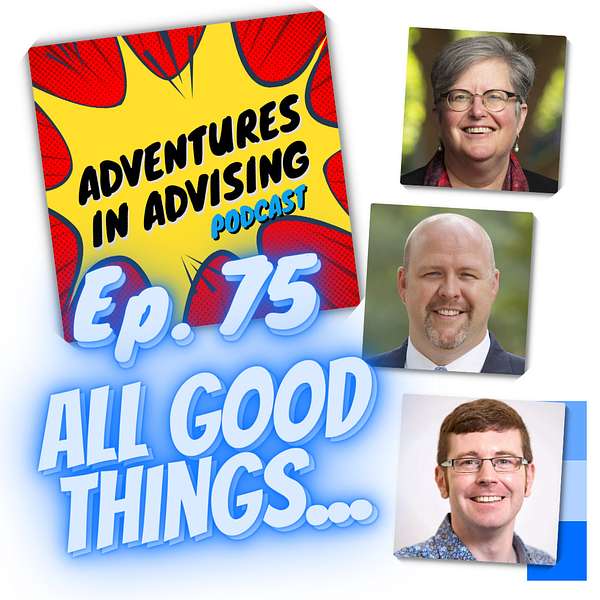
Adventures in Advising
Join Matt Markin, Ryan Scheckel, and their amazing advising guests as they unite voices from around the globe to share real stories, fresh strategies, and game-changing insights from the world of academic advising.
Whether you're new to the field or a seasoned pro, this is your space to learn, connect, and be inspired.
Adventures in Advising
All Good Things... - Adventures in Advising
Welcome to Episode 75 of the Adventures in Advising podcast! In this episode, we end the current run of the podcast. We're chatting about: Leadership, Technology, Advisor Training & Development, Advising Communities, Publications, and more!
You'll hear interviews with:
Dr. Jennifer Joslin - Drury University
Ryan Scheckel- Texas Tech University
And Colum Cronin from Dublin City University returns to guest host!
The Twitter, Instagram, Facebook and TikTok handle for the podcast is @AdvisingPodcast
Check out and bookmark the Adventures in Advising website!
Also, subscribe to our Adventures in Advising YouTube Channel!
You can find Matt on Linkedin.
Follow the podcast on your favorite podcast platform!
The Instagram, and Facebook handle for the podcast is @AdvisingPodcast
Also, subscribe to our Adventures in Advising YouTube Channel!
Connect with Matt and Ryan on LinkedIn.
Matt Markin
Hey, this is Matt Markin, and welcome to episode 75 of the Adventures and Advising podcast. In this episode, we have Jennifer Jocelyn from Drury University, Ryan shekel from Texas Tech University, and a special return from Colum Cronin from Dublin City University. All good things must come to an end. Let's get to the episode.
Matt Markin
Well, a final, hello and welcome to the Adventures in Advising podcast. It's January 2023, and I am recording what is episode 75 and the last episode of the current run of the podcast, as I've mentioned in previous episodes and conversations I've had with many of you since October, the Adventures in Advising podcast started as a fun idea that has turned into three years, over 35,000 downloads, hundreds of guests and plenty of hours of inspiring and timely interviews on so many topics in higher ed and academic advising, I've had the pleasure of bringing you content that I hope you've been able to use, whether it helped motivate you or learned from and applied the tidbits given from each story told by our guests. This foundation of the podcast started with a random idea between myself and Colum Cronin that turned into recording short interviews back in 2019 at a NACADA annual conference with Charlie Nutt, CheriSouza, Ben Hopper, Ivette Cruz, Craig McGill and Ryan Scheckel. Those interviews became the first two episodes of the Adventures in Advising podcast, and we had always feared that, would people find interest in the podcast? Would people find anything beneficial from hearing stories from those in the academic advising field? If there was an interest, would it slowly fade away? And would we be able to sustain this podcast that has really been a side project that's been done on our own time outside of our regular jobs? So trust me when I say that those questions ran through my head on a daily basis, and as each episode came out, though, you know, we saw and heard and felt the support that was showed by so many and that gave us the motivation to keep going. And even when Colum moved on from the podcast, there was so much love and support for the podcast to continue, your positive comments, your suggestions on guests, your offers to help to guest host prove that we in academic advising are a community, and you wanted this podcast to succeed, you saw the benefit. You've shared interviews that you've loved. You've shared about how you connected with and learned from the guests, and you've shared how certain episodes have been part of your team's advisor, training and development. I'm still in awe and still can't fully comprehend how this podcast has had an impact on many of you, and all I wanted to do was share stories, and you've taken that for the last three years and elevated this podcast to such great heights. So thank you to every guest who volunteered their own time to share their stories and perspectives. Thank you to each listener for taking the time to check out most, if not all, of these episodes. This podcast has grown because of you and we, all of us, we did this together. So what happens now? A lot of it, I don't know. But what I do know is that all of these episodes will still be available. So if you missed out on any of the 75 episodes, or want to re listen to any of the interviews, you'll still find them for years to come. But also, I know that I'm going to take a little bit of a break. How long that break might be, I don't know. Couple months a year, who knows? But my hope, though, is to continue the podcast, but maybe in a different format and not with the same consistency as this run over the last three years has been, having said all of that from the bottom of my heart, thank you. And with that, let's get to our first interview of episode 75.
Matt Markin
So before we get to our first guest, let's give a warm welcome back to former co host who is returning back for this last episode for the current run of the pod, and that's with Colum Cronin from Douglas City University. Column, it's been a very long time. Welcome back, my friend.
Jennifer Joslin
Thanks, Matt, nice to Nice to be back and you have steered the ship masterfully over the past little while through the covid waters and through the transition back into, I suppose, more traditional learning experiences for people. People, but obviously all the people involved, it has been interesting to watch the journey from afar, and lovely to be back on on the ship before maybe it docks and and who knows, as you said, what, what the future lies in store. But yeah, great to be back.
Matt Markin
And we could have had this last episode with having the band back together. So how's life so far?
Jennifer Joslin
Good. Things in Dublin are pretty good, and obviously in the world of education, it's I suppose we're all facing similar challenges in many respects, and I'm sure we will get into those with our guest in a personal level, it has been an exciting few years in terms of covering the the NFL and what has come. Come with that that has been a lot of fun, and getting to go to games and cover them as a media member, and I will be in Arizona. So if we have any listeners who are down there in in Phoenix, I will be there for the Super Bowl week. And you know, still love catching up with with people. So definitely let me know if you will be in the Phoenix area. I'm there from the sixth of February to the 13th. Is when I fly out. I still don't pronounce h's in th words, Matt.
Matt Markin
I'll still make fun of you for that, and you're probably making a lot of people jealous, those that may not be able to be in Arizona and for the Super Bowl. But let's go ahead and let's have both of us here. Let's welcome to the podcast. Dr Jennifer Joslin. Dr. Joslin works at Drew University as Associate Vice President for Academic Affairs and director of the Robert and Mary Cox compass Center. She is a former Nakata president and current NACADA consultant. Dr Jocelyn recent, most recent book is advising LGBTQA college students. co-edited with the brilliant Dr. Craig McGill. She is co-editor of the academic advising edition of new directions in higher education and the new advisor guidebook and academic advising administration, among other publications. Dr. Joslin helped envision and globally implement the NACADA e tutorials module for professional development of advisors and administrators with George Steele and Elisa Schaefer. Dr. Joslin earned her AB at Occidental College and Masters and PhD at the University of Iowa. She is a former chair of the NACADA LGBTQ advising and advocacy advising community. She is wife to Kathy Davis, mom to Melissa, Anthony and Truman, and a proud member of the Jane Austen Society of North America. She lives on land belonging to Kickapoo Osage and Sioux peoples. And if you want to connect with Dr Jocelyn, free feel free to contact her at jjsolin785@gmail.com. Jennifer, welcome to the Adventures in Advising podcast.
Jennifer Joslin
Thank you so much, Matt. Colum. What a what a treat to be here. I'm I'm very excited and and and excited to talk about all things today.
Matt Markin
And Truman just celebrated a birthday?
Jennifer Joslin
Three puppy years old. He's very mature. He started talking back a little bit. You have to be really careful. And I'm not the only one who's dog crazy. I don't think on the this, this broadcast today, so I'm in good company.
Jennifer Joslin
You are indeed, and we are delighted to have the opportunity to talk to you. And it's great because it has come full circle. So when Matt got in touch and was saying to come back on for, you know, this kind of final iteration of this version of the podcast, at least, and that would be chatting to you. I was very excited, because my NACADAjourney began, Jennifer Joslin with that conference in Dublin. And I don't know if you saw this, but look, and listeners won't know, but I am wearing a K State t shirt because we need a gift exchange. And I was given Jennifer Jocelyn, who I knew nothing about at that point, and we were given each other, and Jennifer gave me a K State t shirt that that is going back to the summer of 2018, and I still, I still have it, and I felt fitting to wear it, yeah, I suppose that that kind of leads me into, you know, the the first question, the the origin story, right? Everyone has it. I mean, you can go to Greek mythology, or you can go to Marvel superheroes. There is an origin story, and I am very interested, given the career that you have had and the achievements that Matt has listed there in your bio, like how talk to me Jennifer and talk to listeners about like, the journey and how it began. For you and where the interest, I suppose, in advising come from?
Jennifer Joslin
Well, that is such a great lead in though I am feeling the pressure to match Greek mythology and the MCU. I don't know if I'm if my story is quite up to that, I will say that I thought I was heading to graduate school. When I went to graduate school, I thought I was heading towards a life of being a professor in the sociology of sport. So that was really the love I went to undergrad in international relations. But in terms of being 22 in 1982 and coming out 86 sorry, in coming out and thinking of what it would be to be an LGBT person in the Foreign Service or an international service, I thought, be honest, Jennifer, that's not going to happen right now. And so I did a little retooling, and I headed to graduate school trying to combine my interest in women in sport with the study, kind of the critical study of sport. And so off I went to graduate school. And honestly, if I had had a little bit more confidence in my ability to write in that field. I might have never become a professional advisor, but I worried that I didn't go home and think of 12 different paper topics every night on the bus ride home. Instead, I went home and I wanted to garden, and I wanted to have a life and to build a family, and I started to look around, and I had colleagues who had worked in the Advising Center at the University of Iowa, go Hawkeyes, and they they still got to work with students. We actually got to work with the whole student, not just the student who was showing up in my Women's Studies classes, or not just the student in my sociology of sport classes, but the whole student. How did they come to those classes? What were they doing? Where were they from? And I just fell in love with the conversation. Or, as we say, Drury, the slow work of great advising. And that conversation, I feel like I've been in a conversation with students since 1995 really, which is when I got my first job in advising, and I loved it. I started writing in the field. I started I had great bosses who encouraged my professional development, and so I just had the opportunity to get more engaged, and I found my writing confidence. I've always been overconfident when it came to teaching and speaking, so that wasn't an issue but, but my writing confidence, my ability to produce works and edit and go through the process, has really built over time. So yeah, my origin story is there's a door open somewhere, and I don't know, maybe, maybe I practiced like marching through the door and being a superhero. See what I did there on once I got to the other side of the door, I don't know, but I really have loved this field, and I loved it almost from the probably from the very beginning.
Matt Markin
Well, I'll say that is a pretty good origin story, and you have done a lot. I mean, we fast forward to 2022 you are also the winner of the Virginia Gordon award for excellence in the field of academic advising. And for those that don't know, the Virginia Gordon award is a Lifetime Achievement Award. It's celebrating significant contributions to the field of academic advising and various areas so from like research publications to leadership in the advising field to commitment and advocacy to advising. So for one beleta, congratulations on that. What was it like being nominated for and ultimately winning that award?
Jennifer Joslin
Well, it was a great honor. It It's, um, I mean, it is a lifetime achievement. And so I really, I really feel the honor of that and the the time to take just a second to think about my different journey, all the paths. One thing I think is kind of fun is that, and I talked about this a little bit when I said thank you at the conference, is that I'm, I'm one of those transition people. I knew, people who founded NACADA and and still know, like Tom gryts, you know, folks who are still active in the field. And I knew a lot. I knew I didn't know all the early presidents, but I knew a lot of those presidents up to now, and also right now, I have a chance to see the leaders of tomorrow. So there's a little bit of a really neat transition point where NACADA. It was just coming out of its reorganization in the 2000s and now we're transitioning to a really great org where you can be a leader in 100 ways, which was a visionary development, as opposed to when I was coming up, which was you were supposed to do this, and then you did the next level, then you did the next level. And the reality is now you can be a region podcaster. You can be an international podcaster. You can be a writer in 10 areas. You don't ever have to be president for for folk, for you to have an impact in the field, because there are so many different media, there's so many different outlets, there's so much respect for expertise regardless. I don't know it's, it's, it's pretty cool how we have developed. We just have to get through what I think is a tricky period right now in terms of the pandemic and professional people joining the professional organ and recommitting to professional development. But yeah, I'm optimistic.
Jennifer Joslin
Jennifer, when I suppose I think you are synonymous with leadership, right? And certainly in my mind, and I think in many people's mind, you've held different leadership positions. I know it's an area of interest for you, even when you spoke earlier, you talked about the brilliant bosses that you've had. So you recognize the importance of leadership, and I'm always fascinated. And I think Matt will know this, because I probably bring it up in a lot of interviews. But when you get to speak to people who've held leadership positions and who've been successful, and you've heard other people talk about because you talk about great bosses. I've heard people talk about you as a great boss. I'm just interested in hearing about, like, what you feel makes somebody a great leader, and I know that is a large and kind of abstract question in many respects, but just you know from your perspective?
Jennifer Joslin
Oh, that that is a great question. And the neat thing about that question is there are as many answers as there are types of leaders. So I have worked with people who had very traditional styles, and because that was the style I grew up with, you know, I was able to respond and fit into that style. But I have, really, I have learned something from every boss. If you're thinking critically in a in a good way, not critically in a bad way, but if you're, if you're really thinking about the life you're having or the experiences you're having, you can learn anything from any situation. Now, the challenge of implementing that, you know, I've made mistakes on the way. I've learned from those mistakes. I've cast my, my my net across campus to see if my, if my current boss, wasn't somebody whose style matched mine. Then I looked across campus to see if there was someone else I made the call. I tried to get to know them better. There's, there's an engagement to being kind of supervisor you need and the kind of supervisor you wish you had, and always aspirationally, the kind of, the kind of boss that you, you know you can be, if you would just put some pieces together. So I don't I, yeah, it helps when you have terrific people, which means that hiring is probably the most important thing any supervisor does, and it's easy to get caught up in your regular to do list and not really slow down and pay attention to hiring. And so that makes a big difference the people you have, the the the respect you have for them, the always wanting them to do what they need to do. Sometimes it's fly away and get an even better job. Sometimes it's try something new. Sometimes they have to tell you to get out of the way that somehow you're you're engaged, you're managing them too closely in a way you didn't realize you were doing like, I I don't know. It's an, it's an on, if you're if you're good. It's ongoing, it's humbling. It's always trying to do better. It's listening harder. It's making mistakes and learning from them. It's, it's apologizing, it's managing up. Yeah, it's, it's a, it's a big job. But it's also, I don't know, people are pretty terrific, and advisors are are part of that part of that workforce. I think they're usually pretty cool to talk to, and pretty cool to to see them grow and see what they can do with students and and for students, etc. I don't have a magic answer. Are there?
Matt Markin
That was a lovely answer. I think all of agree too with that. I mean, it's just like you're saying you can learn from every situation. But then also, like with with your employees, it's knowing when to hold on and when to let go. You know they have a better opportunity somewhere else. Now, speaking of where you're at, at Drury University, like, how would for those that don't know much about your institution, like, how would you describe your institution, and also your specific roles and responsibilities there?
Jennifer Joslin
Yeah, Drury is a change of pace for me. I started at a small, private liberal arts institution in California, and then with going to graduate school at a big, big 10 University, and then going out to work at Oregon in a PAC 12 big university, and then being at Kansas State at nacotta, big university. I'm harkening back a little bit to my early Pat, my past, my early years at a small private liberal arts. Drury is not just a liberal arts, but it also has professional schools in education, business, architecture. So it's actually an nacu, which is a national comprehensive university. So we think of the University of La Verne out west, and other schools I can't think of at the moment that are part of this particular category, and we are, you know, small and plucky. We're about to celebrate our 100 and 50th year, and it is a faculty focused advising model, but we have robust student support. And one of the neat things about Drury I got here, and they had just revamped their academic platform to do something called, they're calling fusion, which is a focus on classroom experiences, but also career development. And they and and so the academic program focuses on very practical experiences embedded in the classroom, but they also had major donors to contribute special faculty positions, special faculty advisors who would be connected to our center. So our center does Advising, Career Planning and Development, accessibility, Disability Services, Tutoring and Academic workshops. And now we even have national fellowships and study abroad in our area. And so there's money to support faculty who want to do special programming, who want to work very closely with students. We've gotten to do a council of Independent Colleges net view grant, which really does a lot with small colleges, and they have helped us do a two year grant on calling and vocation, so to not just talk about vocation, but to talk about who are you and what are you called to do. And you know, even when I was doing work like I represented NACADA to the Lumina Foundation, the Gates Foundation, achieving the dream Complete College America, even then, it isn't all about just completing the hours to get the degree. It's about what are students learning in the classroom, and now it's a pleasure to do that every day. Who are you? Where are you going? Why College? What's interesting to you? So? So faculty are having those conversations, which is energizing to listen to how faculty work with students, and it's, it's also just fun to think of programs to help students get engaged, ask those questions and and do great things. So it's, it's energizing. I always say that professional like advisors should have administrators. They should have a rejuvenating experience late in their career, something that carries them through, like the last five years, something that is different and interesting, and just jump starts the passion they have for the career, and this is it for me, definitely love. It's yeah there, there's the normal uniqueness of every school that are super fun. But this is a, this has been a great, great career move. It's really cool.
Jennifer Joslin
As somebody who has worked at a number of institutions, yes, those quirks and idiosyncrasies that exist at every institution. You know, are always entertaining, but I think you can hear, I mean, look at the passion that comes across in terms of what you're talking and it was really interesting to hear what you're doing. Now, I want to take you back a little bit, because I was doing some research. Chat, obviously, for for this, and I actually came across a video that you were you did way back in 2011 with Eric Stoler, who spoken to a student affair that is live. And I mean, at that point again, your passion really shone through. And I suppose I'm just, you know, it kind of goes back to a little bit around your origin story, but particularly, maybe tying it into because you can hear the way you talk about advising. But I'm thinking of the fact that you know, you were involved with the new advisor guidebook, and kind of looking back, but and where you are now, for you know advisors or new people coming into the field in particular, like reflecting on maybe the book and your past experiences, what are the things that you think maybe advisors need now have things changed Since you were involved in that publication. Jennifer, or really, are those core skills still the same?
Jennifer Joslin
Well, that's a great that's a great question. The short version is probably the core skills have remained the same, the ability to once you get through training, because training is in your first you know, your early year, or early two years, while you're still trying to figure out, like, What is my name? What am I doing? Who can help right now? But once you get through those early years, the ability or the need, the importance of an advisor looking up and doing the landscape scan. Do I understand exceptions? Do I understand policy? What? What do I need to learn next in terms of technology, or in terms of how, how the course, approval process, like you're always looking at a looking up. I had a friend describe it once to me that advisors impact individuals every day in their offices, and then as you grow in the field, your ideas, maybe your position, certainly your reach, slowly but surely, you might impact one entire class, or you might impact the whole first year class, and then slowly, you know, you get to see more when you look, when you when you look up and look around, and your reach potentially can grow as far as you can see. So the things about understanding just the two and three and five and 10 year goals of thriving in this profession and building knowledge, building expertise, where you at some point go from learning to teaching, and so you're the person now who's Teaching the new advisors, or training the new advisors, or rising from advisor to lead advisor, or lead advisor to assistant or assistant director to associate dean, or something like that. Like, like that's that sounds like an ambition calendar, but it's actually also an experience and knowledge timeline to those are things that happen if you take advantage of the opportunities to look up and and affect change over time. So So that part is the same. New advisor goes through that cycle that you know, Pat Folsom at Iowa first wrote and talked about, but I think now this transition period, because, as you say with the Eric interview, like I was right there when advisors first started to use Twitter, and think of academic advising chat and all the programming and everything that has resulted. And now we have this explosion of media, and who knows what we'll be doing in five years, but the covid period is again an inflection, a tipping point, a point at which we really ask different questions and advisors who are advising now but didn't advise during covid, advisors who span covid, and folks who retired before covid, those are going to be some very different generations, the people who are still working Through who work through covid. Golly, just the attention to mental health, the attention to student mental health, the the attention to the challenges, the extreme challenges now faced in higher ed. Those are those are going to mark colleagues of this, of this particular generation. That's my. Yeah, that's my thinking. So they, they have added issues, issues that previous supervisors don't know anything about because they had retired really before these last couple years. That was a really long answer, but they're, they're these. This is a, definitely a reflection point for a lot of people, and for higher ed in general, I think.
Matt Markin
Yeah, and it seems like there's, you know, more needs now, like for a supervisor to connect with, you know, their staff, especially, like you're saying, there's a lot of overlap, where you might have those advisors that worked through covid to now, those that are now starting, and those that did retire. So there's people are in so many different places right now. I could feel it with with a supervisors job.
Jennifer Joslin
You know, we didn't go home very much. We mean colleagues at small private institutions in the United States. I mean, I think less than 10% of them went home for longer, like we were only home six weeks. So this last year, as folks were writing on social media and talking about having to go back to the office, you know, I was, I was empathetic, but I was like, please, I've been here for a whole year before you have been, you know, I mean, so the privilege of bigger institutions that have different financial circumstances that has played a role anyway. It's it's a it's a complex time.
Matt Markin
I think kind of connect to that. You know, you spoke to the did like a virtual keynote session for the Oklahoma Academic Advising Association. And you know, you spoke about grace at work. You talked about sociologist Ray Oldenburg work. You know, part of that was healthy individuals are part of healthy communities, and vice versa. And that it's, it's a place where people can find themselves, they can drop in, they can drop out. It's, but you talked about people needing three places to feel accepted, and you know, two of them were, you know, were home and also work, and then that individuals also need to find, like, a third place. Can you talk more about, like, having those places, like those safe spaces? Because I think sometimes too, especially during covid, like work and home, ended up kind of blending into one.
Jennifer Joslin
Yeah, yeah. And absolutely. And this, again, is in part, also issues of privilege and the you know, it's kind of wrapped up into your situation, either as a family or financially, during this difficult time, my kids have have grown up and left the house. And are, are are either with my you know, they're with my ex, and my daughter's with my ex in Kansas City. My son is on his own in Lafayette, Indiana, and so during the covid period, my third space was my neighborhood, and once we came back, I had work as a separate location. I had home as a separate location. We had virtual church that played a big role as a third space for me, certainly being in my neighborhood and being home with my partner, Kathy, that was a big source of joy and relief. Missouri had a very, I'll say, interesting response to the pandemic, and so we probably were out in the public period, certainly more than in Ireland and other parts of the European Union, and more, I assumed, than California. So it was, yeah, it's, it's, it's informed by region, it's informed by by class. It's certainly informed by race and also family members. Family members were doing as well at that time. I didn't have young children, so I wasn't also navigating elementary schools and middle schools and high school schedules, but other members of staff were and so it was a complicated time, and not everybody had had the release and relief that comes from the self knowledge that you need. You need lots of. You need at least three, but many people have more.
Jennifer Joslin
So yeah, and I suppose one of the the impacts that we saw during the pandemic was especially on the technological side of things, and I know that's an area that you've obviously been involved in for a long time. And I'm just like, they're the last month here, certainly, and I assume it's the same, has been dominated by ChatGPT. It is every it is what everyone in education, certainly on this side of the Atlantic, seems to be talking about, and its impact, and the different responses, and not, you know, say. It specifically to that, though, if you have thought about a great but just, I'm thinking Jennifer in relation to technological advances, and particularly where we're at AI, and that, does that, like excite you in terms of its impact, or potential impact on advising, or are you cautious about its impact on advising?
Jennifer Joslin
The gosh, that is a complicated that is definitely a complicated question. One thing we're seeing here and right now, of course, as a as a faculty centric University, we are, we are talking about it in relation to students, student writers, student writing papers, those kinds of things. But, I mean, I'm fortunate in that we also have a lot of entrepreneurially minded students and entrepreneurially minded staff and faculty. Everyone is a creator and a maker these days, so that's kind of fun. And so they're talking about the positive uses of ChatGPT, like they're saying, it's like the calculator 50 years ago, right? 40 years ago, and it's a tool, and we want students to show their work in the classroom. So there should be rules around writing papers and and there should be conversations about how it it impacts your classroom experience. But, but our freelance writers staff members who are were writing for they're writing for training manuals. They're writing for in house, documents. They're writing for the web. They they're using it, and it's making their lives and work a little easier. I have stared at my fair share of blank screens wishing I had any idea how to start the next thing I'm writing and yeah, so the conversation around how chat GPT isn't accurate, so you can use it for brainstorming. You can use it, but there's always a mistake, like there's always a mistake, and that's what we tell students. This isn't unqualified. This is just a tool use. You still should construct sentences and practice constructing sentences and things like that, I think, on the on the on the creation of materials for your work, and the creation of materials for the web and things that will make it easier to again, write for your job. I think it will be, I'm I'm cautiously optimistic. I don't want students to use it for their for their resume. I don't want advisors to do it for their letters of recommendation for med school. You know, I think that there is analysis and critical thinking and reflection that should be part of this. So that's kind of my, my early take, are you two at schools that are talking about it in relation to advising in ways I haven't thought of.
Jennifer Joslin
No, I think much like what discussions at your university right now, it has been particularly on the impact around essays and assessment. But I would probably have the view that this is something like, you know, the calculator, the printing press, the this, this is, is a game changer. And I think as we talk now, at the beginning of 2023 I don't think we're even aware of the potential impacts. I think a bit like, you know, the imagined future of the Jetsons, right? And there were aspects of it. We don't have the flying cars, but we do have the devices where I can talk to somebody in their face. And here we are doing that right now. And I just think it's, it's fascinating. I think what you said was that ability to put something on paper and then, and the hope, I suppose, is it might take some of the that kind of, maybe the beginning part, allowing you more time. I mean, I think the ultimate aim of technology, and I know Matt, we talked about this with Eric and others, was to hopefully free up time to allow you to spend then with students and that, you know, but I just find it certainly in over here, and it's fascinating, but it is the assessment piece that is dominating, is the response to it. Because you, on the one hand, you have a lot of faculty and a lot of people within the university, including advisors, saying, This is great. We need to see how we engage with this and think about it. Talk to students, much like you said. But equally, on the other hand, you have people who are saying, This is terrifying. We need to go back to pen and paper and closed off assessments. And lock everyone in a room and No, no, no technological devices. So that was to me, talking to somebody like you who's in the field and interested in technology, and hearing your thoughts. I think that is really good for for listeners, because I do think it's a debate and it's a discussion that will be ongoing and that does need to be had.
Jennifer Joslin
Yeah, yeah, I agree. You know, I the spread of misinformation and the ways in which as a society, we are really impacted by multiple channels of dubious or concerning habits and trends makes me a little pessimistic about our ability. Well, there's obviously not going to be any control of this, so I just I try hard, I try hard. When I try hard to be optimistic, but I should never underestimate capitalism. I think as the older I get, the more I think, Wow, this could be something for good. I wonder where we'll go so that those are concerning. We're just at such a concerning place in terms of our ability to critically analyze, think and and share professionally, ethically, those kinds of things. So those are some moments of concern for me a little bit.
Matt Markin
Maybe we'll do a follow up special episode in like a year, and we'll see where things are at at that point.
Jennifer Joslin
Please don't play this even in one year. But yeah, we're all missing our jet packs. I just, I just want to say that was supposed to be delivered.
Matt Markin
Jetsons, back to the future. So so many shows, I'm like, we were supposed to have that already.
Jennifer Joslin
Yeah, yeah.
Matt Markin
So, you know, one things that you've also done a lot is is published, and you've edited, and one of it was recently, was the book you did. You co edited with, with Craig McGill, the advising LGBTQIA college students. Can you tell us more about the publication? And you know why this is important, why and what's in it for, in there for advisors to be able to use?
Jennifer Joslin
Oh, gosh, that is a great question. There's so much. There's so much in that book. There's personal journeys. There are important facts to situate readers of where we are, kind of in these early, early 2020s as it is, and there's good data and research captured from a wide variety of authors in a variety of fields. So it's not at all a unidimensional look at so and solely from one field, the field of advising. It's their student health professionals, their professional counselors, there are career specialists, there are campus activists, there's and really, really smart people and great writers who were part of this visionary book. One of my smartest writing decisions is to write with other people. I love the process, and, and, and I've had just the privilege of writing with like, like Craig McGill, who is, who is one of those people who can wake up in the morning and go to bed at night and have thought of six other things he wants to write about. Like, when you see people like that, you think he you know he's doing exactly what he should be doing. And I've also written with when Wendy Troxel and Pat Folsom and Frank Yoder. I've presented with CJ Venable, another absolutely visionary thinker, writer, speaker in the field. So the process of casting this net pretty widely and and hearing from not only folks in advising but throughout the landscape has made a big difference. So you can and one of the cool things that that Wendy Schindler and Sarah Stevens and Craig and many others. I shouldn't name names, because I'll miss somebody really also wanted to hear from colleagues in the field and their journey to understand these issues, these complex issues, and how to help students. So they're actually voices from our colleagues about their own journey to understand queer and LGBT and trans student experiences. So there's personal connection, there's data, there's latest research, there's lots of great vignettes and case studies. I think there are a lot of access points in this. Book, and I and I hope folks will take time to thumb through and look at it.
Jennifer Joslin
Yeah, and I think that you know it is a lot of you know, even what is you talk about in the book is so transferable to other groups. And for I'm thinking in an Irish context, in particular, like we have undergone massive changes for the better in terms of diversity on this little island in just, you know, the space of a couple of decades. And obviously this, this over the past couple of years, we have had a huge change to our society in terms of diversity, and obviously in taking people in from the conflict in Ukraine, and I'm thinking like of colleagues and across the I can see from this book, like the we're suddenly dealing with diversity in Irish universities. And up to now, it was maybe just so international students who came on a study abroad semester. This is obviously very different, so there's a lot that can be taken from that. And I think maybe Jennifer, because it was interesting. Like you talked about, like, you know, collaborating with others. And you talked about, like, Craig comes up and has lots of ideas, and you approach things in different ways, but there will be people kind of obviously listening, you know, and you have done the presentations, and you've done publications, you know, who operate in different ways. I'm just thinking like, you know, for you, like, is your advice to try to find somebody who thinks in different ways, or, like, how, for somebody who's starting out and is like, is thinking, I have an idea. I'm really interested in this topic. Like, what would your advice be in terms of going to build, be it a presentation or a publication.
Jennifer Joslin
And I know you've given this, I mean, Wendy Troxel is an unending source of great advice. She will say you have to write with someone if you're going to write with someone, write with somebody who doesn't procrastinate the same way you do. So that's that's a critical piece that you you bring out the better nature, the better angels of both of your natures, instead of the oh, we're supposed to meet. I can't meet. Can we put it off? So that is always practical advice, right? With someone who brings out the very best and who helps you meet deadlines and vice versa. But the the, gosh, I, as an early graduate student, I had a professor actually had a lot of experiences, even in undergraduate, where professors taught me how they think and and I remember one time going to see a professor, and he had just opened his mail, and he held up a book, and he said she wrote my book. So he had a colleague who wrote a book before he could. And then I had a graduate professor who said, speaking is great. Conferences are great, but you have to write to influence the field. And so I am definitely a speak keynote like that is mainly where I have have done extra in terms of extracurricular but, but writing in the field is very important. So try different things. Try writing by yourself. Try a small thing. Try writing with others. Write with a group of people. If you're just starting out. Give it a shot on your own, but don't ever be afraid. And you should always, no matter what you do, you should always be talking about what you're interested in. That's what we tell students who are trying on different callings and vocations like talk to people about what you're thinking about, because somebody knows somebody who has tried that or done that, or can can recommend something to you and and that's what whether you're a graduate student, a new professional, whether you're an advisor who now feels comfortable enough to write and do do further work, get your courage up a little bit and give it A go. You'll find the right thing for you. And I know I was listening to a former podcast where they talked about when you give a presentation, if presentations are kind of your jam, make an outline and use that outline for the presentation as your first draft of something for academic advising. Today, the biggest mistake you make is not trying something that that is, that is a life filled with regrets, and it's no fun at all. So give something to go and then talk to people, because somebody will help you take that further.
Matt Markin
That's. Great advice. And, yeah, I mean, I think the confidence part is a big one, because we can easily tell ourselves not to do something, or I'm not good enough for this, but it's just, and I think for some people, to even me included, it's always that the starting of it is 100%.
Jennifer Joslin
Absolutely, and everybody faces a blank page. I mean, some people can get through the the page faster, get it going faster, but everybody, everybody struggles with starting or they have 1000 ideas and they still can't write that first paragraph. So very common, much more common. And the more we talk about our process, the more we norm it out for other people so they really hear it's not like CJ or Craig, sit down and write a book in a night. You know, everyone, Sharon, everyone involved in the field, we all struggle.
Matt Markin
But just like you were mentioning, like with the because I always quote Wendy, because she's always the one that's always said, like, record your presentations, because literally, you transcribe it. That's your initial outline of a manuscript. So yeah, trust and believe. But Jennifer, this has been a fun and informative interview. I mean, this has been a joy for the both of us to have you here. And thank you for being on the podcast with us today. And I guess we can end with a quote that you've used before in presentation, and that's quoting from Galaxy Quest, and that's, never give up and never surrender Absolutely. Thank you so much for being on the podcast.
Jennifer Joslin
Jennifer, thanks for having me. It is such an honor and a privilege. And many, many. Thanks to both of you for your commitment to the field and everything you've done with the podcast. It's a work of it's a work of art and a thing of beauty.
Matt Markin
I appreciate that. Thank you. Thanks so much, Jennifer for being on the podcast. I appreciate your stories and sharing your thoughts on all things, advising and thanks Colum for jumping on one more time for this last episode. Now on to the next interview.
Matt Markin
Now we come to the last part of episode 75 and let's welcome back to the podcast. That's Ryan Scheckel from Texas Tech University. Ryan, hello there. Hey, Matt. Good to see you again. Good to see you too. And last couple times you've been on it's been serving as a guest host, most recently interviewing John sauter back on episode 69 titled longevity in advising. And now you're back for us to interview you, and for those who don't know or might have forgotten, Ryan was the first guest ever on the adventure set of housing podcast. And I thought, what better way to end the current run of the podcast than to have Ryan back on and be the last guest of this podcast? So you've been on multiple times. What are your thoughts on being this last guest on episode 75.
Ryan Scheckel
I can only speak about, you know, my own perspectives and in my own issues in life, I guess. But it's hard not to be like the beginning in the end. You know, there's some folks out there who get the Alpha and Omega reference, and I'm gonna definitely step away from that. I'm going to say also that it really is, you know, just a testament to you and your vision for the podcast. So if anyone doesn't like it, it's Matt's fault, is what I'm saying. No, I am honored. I was honored when you asked to interview me for the first time, and it was an honor to be involved every single time and part of this podcast, it's a significant effort and a significant contribution to the field of academic advising. And certainly for myself, I want to make sure that that's very clear. I know that you have your desires for what this means and where it goes and how it has an effect on people, but me, personally, getting to be a part of it at all has been a real joy, a real treat, something I appreciate very, very much.
Matt Markin
You know, I remember, yeah, asking you on Facebook back in 2019 like because we were both going to be going to the NACADA annual conference in Louisville. And, you know, I felt like a kid of sorts. So I'm typing up this message like, how am I going to ask Ryan? Can I interview him? And hesitating on clicking that send button. And then once I sent, it was like, Oh my gosh. Can I get that back? Can we rewind time? And then you answered, probably almost immediately after that, let's do it. I do remember when we're about to record, I was so nervous to actually record and actually interview you that I stalled to actually hit the record button. So I was just trying to have this longer conversation, and eventually you said I something along the lines of, all right, so we're. Gonna get the show on the road.
Ryan Scheckel
Maybe that sounds like me, I'm I'm good for any kind of diversion, but when I see a good idea, eventually I do like to get to working on that good idea and and, you know, we've had so many conversations, like for the listeners and viewers. You know, Matt and I have talked around so many things and about so many things that the purpose of our actual meeting isn't about that it's old hat for us to go tangential, all over the place at this point. But I do think that you know, it's there's real lessons to be learned for people out there who might be listening and that are that are hesitant, especially about collaboration and contribution in the field in any sort of professional sense like it. I know it can seem like I don't have the time, I don't have the capacity, I don't I don't, know, have the credentials or whatever. And that's that's just never been my experience with academic advising like I felt it, of course. I mean, I How do you not? I've been in academic advising for nearly 21 years, and and my first annual conference was in 2003 in Dallas, and I was wowed by what people were doing in the work that I did on a daily basis. And sure, you can feel that gap between where you see yourself and where you see other people doing things, but I have never once in my experience of reaching out to a colleague or somebody in academic advising been like shut down or discouraged or actively left out when I made the offer or the step toward them. And I think that's one of the things that you know now. I accept it as a given that if I make even a half step in someone's direction, that they're going to meet me. And that's It's so wonderful to work in a place like that, especially with all the other concerns and frustrations and challenges that we face in academic advising, to know that the people who do our work. Art is really something that, I think, again, goes under appreciated as far as what it means to do our jobs and to be in this field.
Matt Markin
And it's been a while since, I mean, I interviewed you when it was time to talk about the annual conference in Portland and the art exhibition, but it's been a while since guests have heard your background in advising. So for those that may not remember or this their first time listening and getting to listen to you, what was your background pathway in higher ed?
Ryan Scheckel
Yeah, so, um, I was a first gen student. My parents didn't attend college. My older sister is three years older than me. She stayed in South Dakota when we moved to Texas right before my freshman year of high school, it would have been her senior year, so she stayed with my grandparents, so her going to college experience I never saw so when I was a junior in high school, my high school counselor was also the wife of my head basketball and football coach, so She knew me through that connection as well. And she was like, Do you want to go to college? And I was like, Yeah. And she's like, well, this is the last A, C, T, back then we signed up for tests and paper and sent them in the mail. And so anyway, she was like, You got to sign up now. And so my college going journey as a person was really I was fortunate to have the privileges that I have as a middle class, white, cis, hetero male, because college is built for me, and my inability to meet those expectations didn't mean I failed out. It just meant that I had some rough semesters. I took longer semesters off, but I finished a bachelor's degree. I remember my advisor as I was getting closer and closer. Her name was Joanne, and she was like, you can do this. She was really rooting for me, and she was a great in the College of Human Sciences here at Texas Tech University. So I graduated with a Bachelor degree and had no real plan. Professionally, I taught for two years in the public school system, but through the correctional system here in Texas, which I think I mentioned before, if anyone ever wants to talk about that, believe me, there's a lot to talk about there. But then, as I was transitioning out of that role, I was looking for jobs, and I reached out to a friend who I said, Do you know anything going on? My wife and I decided to move back to Lubbock, where we went to undergrad, because we appreciate it. Enjoyed it so much. And there was an advising job open. That was July of 2002 and it was a part time, you know, summer advisor to work with orientation. And I was like, well, I'll get my teacher certification in history while I do that. And it became a full time job. I was hired full time that December, worked with undecided and undeclared students from basically 2002 to 2006 then I moved into the school of art, and was the only advisor in that department and get it. Got involved in a lot of admissions and graduate stuff, recruiting, curriculum stuff. I was there for nine years, and then I, you know, it was sometime around 2013 when I was like, am I going to do? Is this really this? Is this? It is advising my career. Is that where I'm. To be and the answer was confirm multiple times in multiple ways, that yeah, this is what I want to do. So started saying yes to involvement in advising communities and doing more at conferences than just attending sessions and getting information, but presenting and networking and going to meetings outside of the conference sessions and stuff. And then I got really interested in advising administration and working with a team of advisors again. And so in 2015 a position was created for pre health advising. I have a team of five full time pre health advisors, and I've been doing that for the last seven plus years.
Matt Markin
So, you're mentioning 2013 is when you start kind of questions, if that's the path you still wanted to be in, or the career you wanted to be in. That's when I started in advising. Was in 2013 I left Admissions and Student Affairs to go into advising, and actually questioned myself the first month if that was what I should be doing, because I had a horrible time adjusting for some reason. But then eventually got into it and been here ever since, and you're mentioning doing a filling out a paper, A, C, T form. When I applied for college, I remember still filling out a paper application.
Ryan Scheckel
Yeah, yeah. You know it's, it's funny sometimes when I think about the college student experience now, I if I hadn't been continually employed in higher education and lived through these changes, college would seem so different. I think, you know, it's, it's sort of like I have children of my own. One is 13, one is 10. And you know, when we see people that we haven't seen in a while, they're like, you're so tall and so big. I was like, Ah, I mean, he is, and they are, and they've grown and matured, and they're wonderful humans, but like, we see the incremental change, and it just becomes the norm. And sometimes I, you know, I think about family members who, of course, never went to college, and what's that like? The trust, the fear and the hope that those family members have, but then also people who did go to college, it seems so different. It's not a big surprise. I think that anxiety in general set aside all the other stuff going on in the world, just the difference between what college was like 2030, years ago and going to college and what it's like now, the pressures there and stuff among the challenges that academic advisors deal with.
Matt Markin
With NACADA, like you were talking about, like you've been an advisor and been a member for a number of years, would you say your claim to fame, or when you saw increase in popularity, was the Star Wars presentation in Vegas?
Ryan Scheckel
Well, yeah, that was the thing I don't know. Like, I'll put the two elements together, yeah, something I do that I love, and that's academic advising, and something I'm passionate about outside of advising, and that wasn't something that had occurred to me, I think, that I could do, until I started meeting more people professionally and seeing, you know, like, Sure, maybe, maybe for me, hermeneutics isn't a passion of mine. It's not something that I would connect with academic advising. But when I attended Peter Hagan and Hilary Himes and I think, Janet, I forget who all was there, I apologize to the presenters. It was a while ago, but there was a session about hermeneutics as an approach to academic advising, and I could tell, oh, there's, there's like a real passion that isn't directly academic advising, and how does it relate to academic advising? I was like, you can do that. That can be a way that you can contribute. I was like, Yeah. And, you know, I've talked about the Star Wars thing before, but it was happenstance. You know, Disney had just bought Star Wars and announced new movies were coming, and so I was really excited as a fan. And then the academic advising approaches book was being published, and I felt like advisors, like advisors should be just as excited about that as I was about new Star Wars movies. And so, yeah, connecting passion and excitement with the work that we do today today, I think that's maybe what resonated. I mean, certainly there's also the easy access point that Star Wars is. So the presentation I didn't I'm pretty sure also that the abstract promised giveaways, so that might have helped too. But, yeah, that's that 2015 2015 in Vegas, in that room, about 250 or so people that definitely helped, you know, and and there's a lot of times when I look back at that and think about how simple and easy that was for me, and what made opportunity come my way, I think, is what I've heard over and over again from lots of people who've done the actual research on how do companies or individuals or organizations, how do they sort of take the next step. And it's usually about understanding what you do really well and connecting it with the way you can make the best impact in your way, not trying to do what other people have done and recreate it, but if your passion is refining what somebody else has done, or seeing it from another angle, or whatever, revisiting topics is certainly a great way to make a contribution to a. So innovation, I think, you know, has a lot of cachet in our culture, doing something new and exciting that's never been done before, that has real value. But I think sometimes we need people to go, Well, let's take a closer look at that. Let's see if that really matters, or that's really valid, or if that really makes a difference. So over time, I've very much appreciated the Star Wars effect on my life and career, but I also appreciate that there's lots of folks and lots of ways to make a difference.
Matt Markin
What about like people in jobs, like, you know, you have institutions or, you know, whether it's higher ed or not, that say we want people to be innovative. We want you to have your personality in your position. We want you to enjoy what you're doing. And maybe people have ideas of how they can incorporate their passion with their work, but maybe they hit a roadblock. You know, any advice of how someone might be able to talk with their supervisor about a change or something innovative, or idea that they may have?
Ryan Scheckel
Yeah, I think for the purpose of academic advising, and academic advisors trying to get the support, whether financial or time or just consent, permission, that kind of stuff, to do something that they want to do that's outside of their primary role is connecting it back to the benefit to their students and academic advisors who are active participants in the professional discourse. And that's run the gamut from listening to this podcast or reading journal articles to having conversations with colleagues and building community on your campus, to state to regional, national, international, on up leading volunteering. There's so many ways, so whatever that thing you want to do is the folks who are doing those things bring that value back to their institutions. Like there's lots of ways, but just the knowledge and perspective and benefit gained that encourages me to be better. It helps me be better in the work that I do, and if I'm better in the work I do, the students benefit the institution benefits like that line is a very clear line in the practitioner role, but the opportunity to bring best practices and benchmarks to compare against, even informally, is another way. So not only is your practice improved, but then also the place, the setting that you do, your practice can be improved and is benefited. Then the it's hard to really quantify this or say it in a way that I think doesn't sound self serving, but the skills that I've learned in organization and leadership and communication and idea generation and networking that I do with NACADA or Texan or any of the other organizations I'm involved in, that's skills I bring back here too, Right? So they call it professional development for a reason, these engaging opportunities develop you as a professional and that development benefits your students, benefits your organization, benefits you.
Matt Markin
Speaking of development, at the last annual conference in Portland, you did a presentation called How to get unstuck, what to do when Advisor Training and Development Strategy stall out. So can you talk more about that presentation that you did?
Ryan Scheckel
Yeah, so for the first time ever, I responded to an advisor, or not an author call, a call for chapters, to a book, a publication, 20 years of advising, and the first time I, like, took that leap and and I submitted a chapter. It didn't get accepted, but they were like, Hey, I think it'd be great for a voices from the field portion of the theory chapter for the advisor, training and development guide the third edition. And I was like, Cool, I'm on board. I want to do this. I let's give it a try. And so I went through the editorial process, and everyone was great. And learned a ton about, you know, crafting something for publication, because I'd never really done that. I'd done it with you for the academic advising today, but that was kind of like concurrently those two projects we're working on. So, you know, it was, it was really, really beneficial, and at some point, once things were like, oh yeah, this is happening. This isn't they're gonna reject it, and you're not a part of it. I was like, I've done more work, I feel like, on this written piece, than I might do, or as much as I would do for a conference proposal presentation. So like, that seems like a no brainer. So I submitted it, submitted my chapter, functionally, my voices from the field piece as a presentation. That's the first time in my life I'd done it in that order in all other cases. And maybe it's because I was a teacher first. I created the lesson, the presentation first, and then tried to figure out, how do I get this into an article or paper format? So that was really interesting for. Me. And to be honest, I was like, Ooh, yeah, this is definitely outside of my comfort zone, and I don't think I did as good of a job as I could have doing it the other way around, because it wasn't the usual way of doing it. I kept thinking about the paper I wrote and not the presentation I was giving, but yeah, the presentation was built around this idea that, sure, we can use a theory base for advisor training and development, we can take this idea of andragogy or the adult learner, and we can make sure that our advisor training development strategies satisfy the model and the structures and the assumptions of andragogy, but sometimes especially when it comes to the adult learner, the professional learner, and the advisors that I've known over my couple decades of doing this, there might be places where it doesn't quite do everything. And so there were some gaps that I had identified with andragogy, and I had suggested other theoretical models as possible ways to fill in those gaps to get unstuck. And so that was the presentation. Was basically my voices of the field piece from that chapter in that book, which is really weird to say, but that's what it was.
Matt Markin
Would you be able to share a tip to help with Advisor Training Development?
Ryan Scheckel
Yeah, one of the assumptions of andragogy is that advisors approach or adults approach learning with a need to know. Like, as an adult learner, I have a need. I'm here for a reason, and there are times when I think, as an advisor, I didn't always feel a need to learn, right? I didn't, I didn't have that need. I just wanted to, like, I it's a different thing. Like, there wasn't a problem I was trying to solve or a concern or an issue in my work that led me to seek out learning. I just was interested in learning from the topic. And so it being sometimes when learning or training or development was presented from like, here's the problem you're solving with this, I was sort of like, Nah, I don't really care. And so adult learning theory, there's a couple of different perspectives in adult learning, specifically Sandlin that you know, like sometimes just present things in an interesting way, like just being interesting and in engaging people's interests in a way that isn't necessarily about the problem this solves, but the ideas that are valuable, worth considering is maybe more of a an adult learning theory approach, as opposed to an andragogical approach that says, here's the problem this this learning solves. So that's just one example. I think andragogy assumes as well that we adult learners learn individually, and that isolation was kind of a concern for me, I know, especially when I moved from a centralized advising office for undecided students to a department advising in the School of Art, where I was the only advisor, I felt a lot of isolation. I was the only one doing it, and the person who was doing it before me left. So like, I had to do a lot on my own, even though I have colleagues and supporters, the job was mine alone. And you know, a model that fills that gap that isn't andragogical, is communities of practice. And certainly, you and I have discussed whether or not academic advising, associations, organizations, whether or not they're communities of practice by definition or not. But the connection I felt with other people who are doing similarly jobs, similar jobs, through professional learning, professional social socialization and communities of practice as a theoretical model tends to fill in that gap that andragogy has, or it assumes the adult learner learns on their own, because I did a lot of learning with other people.
Matt Markin
And then one of the other presentations you did was the completion agenda surveillance capitalism and panopticon advising. Can you talk more about that one?
Ryan Scheckel
Yeah, so it's again, talking about collaboration and the value that relationships generate professionally. Jake Rudy, who I kind of only tangentially met at at a previous conference, I was following you on Twitter, and you know, Jake was expressing himself in a way that was very real and very passionate and was sort of frustrated, like feeling like he was inside the machine and not a Real human. And Jake's tweet was something, something, panopticon advising, just like your Facebook post was advising Academy. I was like, yes, that's an idea that immediately has hooks in my brain. And I was also equally frustrated with this pressure to intervene in a surveillance sort of way with students for the purpose of retention and student success, of course, but I was feeling that pressure, and I was like, let's do this. And CO collaborators, CJ Venable and Sarah Howard were like, Yeah, let's I agree. And so we started working on a scholarly paper draft, and again, I was a part of the scholarly paper section. Type from its formation only because I, like I really wanted to see the scholarly work that was happening in presentations, find a structure that's a little bit more tangible than a 50 minute presentation that was a PowerPoint at some city. And so scholarly papers were being built by Wendy Troxel and other people on the research committee with Akata and stuff. And so, you know, it was again, a confluence of energies that I got swept up in. And so I saw them happen. I saw them be birthed through the pandemic, through the virtualization of the 2020 conference, when the just held on tightly to making sure this happened, and I was glad to support it in any way I could, but I hadn't ever submitted a paper for a scholarly paper session type, and then that's what we decided to do. And so we presented that, and it was a blast. We had a great time, and we're continuing to develop it for publication.
Matt Markin
You see yourself doing more of these scholarly paper sessions?
Ryan Scheckel
You know, I'm there's just so many opportunities. I think that I hope, I hope, if anybody is in any way hesitant to step into the arena, so to speak, it's because they're not sure where they should be. There's just so many options, so many ways to contribute. I know that that's not the case, but I hope that, like trying to find the right place is the hardest thing, because there's just so many places. If everybody were contributing professionally, contributing professionally to the field, there wouldn't be enough places for these things. But there's so many opportunities right now. So I don't know, I don't know if that's my intent, you know, to follow this line of inquiry in that structure. You know, we have always have things that I'm curious about and interested in, and I think the opportunity for advisors to have a scholarly paper session type at our annual conference is significant, not just for people who've always been professional staff advisors, like me, but for faculty advisors too, because there's a little bit more teeth there for them in the tenure and promotion process, the participation to say This is a paper presentation style, just like at your academic conferences in your disciplines. So, yeah, maybe. But you know, we were, we were really excited to be given the opportunity to take a critical lens and use a voicing that tends not to be represented in official spaces, right? There's a lot of informal spaces where advisors talk about their frustrations and the negative effects of the work they do. And I think the self care and advisor well being focus of the Association recently reflects that, but it's still in a positive voice. What can we do to deal with this challenge? And my co authors and I were just saying, this is a real problem, and we wanted to document it in the most formal scholarly way that we think that these influences on the practice of advising is creating a style of advising that is unproductive. Should it go unchecked, and that's scary, but also very, very rewarding to have that opportunity to say that. Why do you think it's not more formal? Well, I mean, one of the joys of working in academic advising is that everyone's so nice. And you know, a good friend and colleague, Mark Lowenstein, talked about that at the beginning of the scholarly paper session. Like the purpose of scholarly papers is to take a critical lens to the work that our colleagues are putting forward, to be a critical friend, but still say, hey, you know your methodology can be reinforced. Your literature base is probably out of date. Or maybe you don't voice your argument strongly enough, or maybe this isn't even a valid approach, like that's hard that for someone to make the effort and then get that critique. And academic advising conferences and academic advisors in general, when they're presenting best practices or models or any of their presentations, tend to be like, hey, what do you think about this? And people like, Oh, that's a really interesting idea. And we're all so nice, and so we tend to generate scholarship, and we tend to contribute in ways that are positive. Here's a challenge, here's a solution. Instead of just saying, No, this is a challenge. Period that's significant enough, is the point. And I think that's why I think advisors are just too.
Matt Markin
Sometimes you see you have an interest, or you see something that can have an impact, or you're just curious about something, one of the things you wanted to do and you push forward with it, was the art exhibition that was at the Portland conference. So the first ever, I think, our exhibition at any NACADA conference, maybe higher ed in general. I don't know, talk about that, What? What? What went on with that? Because I know you know, when I had you on the podcast on one of the previous episodes, it was this thing is happening. Here's what it's about. But now that it's come and gone, hopefully continues in future conferences. What's your reflection on it?
Ryan Scheckel
There are some fantastic folks. When I say sometimes advisors are too nice. Is, advisors are never too creative, you know, like, just amazing the work, because, like, I saw it, and sometimes in very rough ideas in the process of the submission, review and acceptance, you know, to the call, but to have it delivered and embodied in front of you, but also with the maker of it there, in almost near all cases, was just so fantastic. I realized that my responsibility is to, in some ways, share this experience here and elsewhere, and so I'm working on that, but it's a unique experience to start with. The it could be possible to seeing it done, not in a self, you know, look what I had accomplished, sense, but look at what our folks are doing, and that, you know, that is just a real joy. It was great to meet the artists and talk with them even more. You know well how easy it is for me to get excited about ideas and just the conversations that we're having, but the to be in the room and be an observer, to be in the gallery and watch people come in and their ideas start generating it was that was why we did it, and it 100% happened. And you know, I can't thank you enough as conference co chair in having a belief that something like that was valuable and meaningful, and the executive office, especially Melinda Anderson, you know, to dedicate space. Farrah Turner did a ton of work. And Dana McNary as well. Like you know, there's folks who really, really took a leap of faith and trusted us, and I'm so thankful for that, because every time someone walked through the gallery, I feel like it was a real positive effect. Even if it was just a quiet space to get away from the hustle and bustle of the conference, it was still so so wonderful, see. And so we had a lot of volunteers staffing the gallery. Of course, we had people who purchased artwork through the silent auction to support the cost of it. It was from everything that I could expect an absolute win and and, yeah, and so as we approach planning for next year, I'm looking forward to working with the annual conference Advisory Board and the annual plan conference planning committee to see how can Orlando refine and improve and build upon what happened in Portland.
Matt Markin
Yeah, it just starts with an idea. And the one thing is, like people who have not coordinated, like, let's say an event or conference, things like that, the attendee that shows up, you know, sure, a lot of them appreciated everything. You know, seeing this art exhibition, seeing the creativity from what was submitted from basically other attendees that were there, and the fact that was able to people were able to give back to the organizations through the silent auction. But a lot of people don't know all the work that goes in, and something that's at this event for a few days took so many months to to happen. So you know, kudos to you and the volunteers and your team that that worked on this project.
Ryan Scheckel
Yeah, we had jurors. So like, just like every conference proposal has multiple people who look over it and and review it and provide feedback, we did the same thing for the art that was submitted, submitted in the art world. If you're not familiar, that's that's called a juror and, and so are my jurors and the attendees, as far as like volunteering and staffing the gallery or whatever, I couldn't have done it without them as well. I think people may have trusted me, but I'm glad that that there were folks who were willing to add their time and effort and expertise in making sure that the approach here was meeting the standards of, you know, a proper art exhibition and, and that's absolutely we had. I know for a fact that people enjoyed it because they walked through and said so and, so that's that's something that's a real plus.
Matt Markin
Aside from that, I mean, you've presented, you were volunteered. You did the organized the art exhibition at the Portland conference. But also you from the county, you've completed your first year as chair of the theory, philosophy and history of advising community. So I guess reflecting back, let's say on that, how do you feel like your first year went?
Ryan Scheckel
You know, I think that the advising community leadership structure is one of those many places where people can make that contribution, and I can say conclusively that community is only as good as the effort that the its members put into it. I ran the. I'm for chair on the platform that leadership and membership development was the focus. And if I can say that, you know, I've learned anything is that building community is a particularly necessary skill set that isn't exactly in my wheelhouse and and so I appreciate so much my steering committee members who did the work, so much of the work that actually happened in the advising community this year. Margaret mckemberin is our steering committee member who's been leading our theory, philosophy and history or TPH talks, so quarterly presentations and conversations around theory, philosophy and history topics. And so that's a big plus. And I had steering committee members who were taking up our priorities about capturing and making a meaningful contribution to the history of academic advising, collaboration with other advising communities for theory, philosophy and history, and the impact that they have on those communities interests, and then also just sort of advising community in reach and conversation. And so we had, I think, a very successful year, but that is, you know, subjective, you know, I feel like we could have done a lot more. I would have loved to seen a lot more members participating on our action groups. And so if anyone is interested in, like, how do I make a difference if I'm not in a leadership role? I'm not a steering committee member, I'm not a chair or whatever. Being an advising community member who contributes, who attends and listens and suggests and gives feedback, is super valuable, too. So what I've learned is it's a lot of work that's really rewarding, and if you're going to do it? Well, community is in the name you need to build community.
Matt Markin
Oh, and year two started as of the Portland conference. So I mean, you mentioned some of the things that, which I imagine are part of the year two goals. But are there any other goals that you would want accomplished within this community?
Ryan Scheckel
Well, the you know, the exciting thing is, elections are going on, or, you know, are coming up, or that process, I'm not part of it now, so I'm like, Oh, I don't know. So I think that the transition from chair to chair has been really great in theory, philosophy and history, and I know that my job in this second year is in part, to make that transition as smooth and and effective as possible. But yeah, I would like to, I think the impact I would my chair tenure, I'd like to leave, is that that the tone of our advising community is more about participation and involvement than the typical tone for our community, which is a lot of great thinkers, people who explore and express ideas really, really well in lots of different ways. Thinkers and talkers are always going to be part of our advising community, but I'm looking for doers. If we're going to build community, we need doers, and I'd like to see more membership and leadership development in this last year.
Matt Markin
Well, I hope that happens, and I think it will when you interviewed John sauter a few episodes ago. You asked him specifically about employees like working at the same institution for many years. You know, it's always kind of the debate of, you know, do you stay at one institution or do you kind of hop around? What would be your answer to that?
Ryan Scheckel
Well, you know, as the historian in me, is always thinking about the evolution of the faculty, at least in the United States. That's the history I know best of higher education. And there was a point where, you know, the people who were instructing tutors, often, they were referred to early on in the colonial colleges. You know their intent wasn't to be a long time faculty member as a career, it was often they were going to make this contribution and then move on into their professional fields of governance or medicine or clergy or whatever, and and it was interesting, you know, in the history of higher education United States, when the faculty and the curriculum really started to specialize, that the faculty started to identify more professionally with their specialty, their discipline, their their content area, and become sociologists and geologists and chemists and biologists and not faculty or tutors. And then their sort of affiliation was more with their profession than with their institution. And I don't know if academic advising is going through a similar evolution. I know that there are plenty of people who choose to get into higher education and into academic advising because of their affiliation and affinity for their institution, their undergraduate institution, the institution where they happen to live, or whatever. And I'm curious if you know when I'm done with this, another 20 years from now, or whatever, if I'll be at the same institution, or if advising will be significantly different. But I think that people need to make decisions that are best for them, and there is a precedent in our field, in American higher education, at least. List of saying My identity is mine, and I will choose to express it how I choose to express it, professionally, personally, otherwise. So if an academic advisor says, I want to be an advisor and retire from one institution and spend my whole time contributing to this institution, there's merit and value in that. And if an advisor says, I see an opportunity to make a difference at multiple institutions over the course of my career. There's merit and value in that as well.
Matt Markin
So if you had your wish, what would the future of academic advising look like to you?
Ryan Scheckel
Oh, I you know, it's funny. We talked a little bit about 2015 and the Star Wars presentation and the book that it was really about the approaches academic advising approaches, book from 2013 I think Lowenstein, chapter on the future of advising. It still bounces around in my head some of the points, some of the salient points, but I it's, it's, it's important to say and recognize that while it's maybe not an ideal or perfect or whatever the reality is. Institutions compete. They compete within their sort of levels or types or whatever. They compete for new students, the best students, they compete. And at no point in my understanding of that competition, you can call it recruiting, or whatever you want to call it, at no point do I recall academic advising being part of that competition. Advising is frequently cited as the solution to challenges and problems, maybe even seen as a challenge or problem at some institutions, but at no point does somebody say, Yeah, sure, our football team is pretty good, but our advising is amazing. And one of the things that Mark said in that chapter, in that sort of projected vision of what advising could be, was that academic advising was noted and used as a recruiting tool for prospective students. And the opportunity, the opportunity to do that at an institution, is something that's really, I don't know, really exciting and interesting to me to establish an approach as an institutional level that says we recognize the individuality and the uniqueness of our advisors and their academic units, but the experience you're going to get, the quality of advising, the difference that advising is going to make in your educational journey here, matters enough to us to say, say it on the front end. Say it's a reason you should consider coming to this institution. I'm not sure that that will happen in the future of academic advising, but I think at some point we need to move from this accountability and expectation model to an aspirational professional model of the way we talk about advising effect on campuses.
Matt Markin
So now we get towards the end of this interview. So taking this from Kevin Thomas, he called this something else. I'm going to call it the speed round. So some rapid fire questions. I guess we'll see if there are rapid fire answers. So what's the best part of being a NACADA member?
Ryan Scheckel
I mean, it's just I think of so many people, so many times, who have made a difference professionally, of course, but also personally, it's i The people by hands down. I love love ideas, I love traveling and seeing new places and that kind of stuff. But I those things don't even come close to the value that the people that I've met along the way have contributed.
Matt Markin
That's part of working in higher ed.
Ryan Scheckel
Well, the fact that there's a culture, you know, like so many people talk about, why are we seeing the challenges in the workplace and burnout and turnover and whatever else we choose to call the ways that people go? This sucks, and I can say that the culture of higher ed continues to be something that I don't know. I can find solace in, even if the culture of my institution or the culture of that interaction with a student isn't what I liked, it's an environment where Learning Matters, where ideas matter, where change and difference is supposed to happen. I think that's really what lands for me.
Matt Markin
For a new advisor, what should they what? What is something that is like a must read?
Ryan Scheckel
Well, so the historian in me says, you know, get a sense of the history of American higher education. There's whatever is the current edition, and whatever course at whatever institution, I think you know, really understanding like how we got here is, is just so important. It has no bearing on the work that you're going to be expected to do once you start working with students. But the context with. Within the I don't know, quirks and nuances of your work environment, understanding the history of academic, history of higher education in your setting is so valuable. But you know, I've talked about it plenty, and I'll continue to say that academic advising approaches is really helpful in letting you know, there's a lot of ways to do this too.
Matt Markin
Do you have any books that you're excited to read?
Ryan Scheckel
Oh, um, I That's it. Books, to me, are like, ideas, you know, they're, they're fleeting. And my answer, like, I don't know if I talked about it with John on the podcast or not, but people often ask me, like, what's, you know, what's you know, what's my favorite Star Wars movie? And my answer is always the next one. And that's, that's the case too. I don't I have plenty on my shelf that I haven't finished, and so I'll just say the ones that I'm excited and finishing is getting that off of my conscience. It's finishing up the books I've started not not finished.
Matt Markin
Your favorite Disney Plus series in 2022?
Ryan Scheckel
So I think Andor is fantastic. I know that they're gonna be a lot of people who are like, there's no Jedi and there's no like, you know, the typical Star Wars feel and stuff. But I have been in the Star Wars literature, the books, the comics, the role playing stuff. For so long. 1997 was when I started that journey and and I was imagining a world that looked like andor, you know, so much just the regular people in the Star Wars world and so and, or is a big one. I haven't watched a ton of others. I mean, I watched all the Marvel stuff, and nothing really jumps out. I mean, I think there's, I think the Miss Marvel was probably pretty important. I think that was a big one, and I think they did a great job with it. But and, or still Star Wars.
Matt Markin
And I still remember you said, Hey, you should check out and. Or I said, Yeah, I will. And then eventually I did, and I was like, Oh my gosh, this is really good.
Ryan Scheckel
Yeah, I need some sort of like, I don't residuals. I don't know how you pay people who promote your product, but Disney owes me so much.
Matt Markin
Let's calculate that maybe you can retire favorite movie you saw in theaters last year.
Ryan Scheckel
I think Wakanda Forever. It mainly, you know, people understandably, are probably maybe a little bit more emotionally raw. And I was really curious to see how they handled the loss of Chadwick Boseman, because he just so, so perfectly embodied that character at a time and place that was so unexpected. And then, you know, his, his loss was so unexpected and on, his hard to manage, I think, like, emotionally, like, am I sad because he was a moody character I liked, or is am I sad because he was a person and it was really interesting to see how well Ryan Coogler and their creative team and the performers handled that by telling a story that also really matters, and tenic, where the Holy Cow as an a more is just really powerful, too. And so there may be people who've already seen it, and they're like, Okay, yeah, we get it. But there are some people are like, I don't know, comic book movies. I'm telling you, there's, it seems like it's been forever that they've been dominating the box office, but there's still really good work happening in there.
Matt Markin
And it might be happening again this year. So I guess, what's your movie that you're most looking forward to this year?
Ryan Scheckel
Oh, man. Um, I think, I mean, I'm really, really curious about with the Marvel Cinematic Universe i and most things I'm curious about the the cosmology the world building, the sort of cultural history and narrative and how it all interconnects. Like, one of my favorite things about Harry Potter and the Harry Potter verse was the the tale of the Deathly Hallows, like, just the idea that this world isn't these people, right? It really gets bigger, and these people are operating it, because that's the world I live in. And so it seems so relatable. And so what's happening with Ant Man, the Wasp and quantum mania and Kang and all that kind of stuff. I know it's the next one, which is my default answer, but it is also the one that I'm like really curious about. I'm curious to see, does the rest of the narrative start to move forward again? We went through so much with the Infinity saga and Thanos and the the return of all those characters and the death of some people is like, we'd like to see where things are going now, and so I'm, I'm hopeful for.
Matt Markin
That is Ben from the Umbrella Academy, still your favorite character of that series.
Ryan Scheckel
Yeah, I'll say that the Netflix series hasn't changed. That for me. You. No, but I will, I will say that I I kind of appreciate the original creators vision more. I'm excited about the announcement for a final season of the Umbrella Academy on Netflix, but, but I'm more interested to see what comes out in print. I'm really, really hopeful for that, too.
Matt Markin
And last question, if you did your own podcast, what would it be about?
Ryan Scheckel
I don't know. I was thinking about, you know, one of the things that I've in the podcast, that I've seen the both, sort of like the video podcasts on YouTube and, of course, the audio podcasts, one of the things that I'm really interested in is when listeners are much more present. You know, because like, I'm you and I have imagined listeners, I really genuinely hope that you've had interactions with listeners in the real world who've like I listen to this, or really like that. I'm happy to report that no one said I heard you on the podcast, and that was like, the first time they knew me. People who already knew me have talked about podcast episodes of me, but, but like, I think I would try to find a podcast that in I would try to create a podcast and in some ways, brings the listener into the space a little bit more I'm not as much as, like a call in situation, because sometimes, you know, but, but some sort of, I've always thought about three question Thursday, like, as a brand, so don't steal it, because it's mine. But, like, you ask three questions, and then you present the results, right? And I think, I think three question Thursday might be the podcast I would do, and I would ask people who are working in higher education, or who are students in higher it'd be like a higher ed three question Thursday situation where I'd ask three questions and they're like, this is what we found out. And talk about it, because I'm always curious about stuff. Always want to know, like, where did this come from? What do you think about that? Is this really happening? Is this what you all think? Like, I got questions and I want answers.
Matt Markin
Awesome, well, and that is the final question of this episode. I should have thought more through. Oh, okay, we can redo no no. Well, I appreciate you being on this episode. Of course, every episode that you've been on, whether it's as a being interviewed or you being the interviewer, and of course, working on multiple projects with you throughout these last few years, and hopefully continue working on future ones in the coming years.
Ryan Scheckel
Absolutely, and for everybody listening, I know y'all know this. Matt Markin is amazing. I'm not saying it because I'm his friend. I'm not saying because he interviewed me. I'm saying it's, it's objectively true. I mentioned it earlier, but this contribution to the work that we do is gonna persist. Like, I'm actually really curious about that too. Like, as much as I'm always thinking about the next thing or the next idea, I'm like, I'm really curious about, like, somebody two, three years from now, discovering the podcast, like, as a little, like, I don't know what do they call this thing, time capsule. You
Matt Markin
know what? I'm very bury it underground. Someone can dig
Ryan Scheckel
it up. No, you don't need to bury it. It's the internet. You know, people are gonna find it and and people are gonna walk away from it going, that was so valuable. I know people already have but that's one of the amazing things about these kinds of intellectual contributions that are published or shared online that exist after they're made, is that impact is just sometimes incalculable. I know, I know the cited biometric in publications is something that they're looking at, because that means impact after it was created. And I know this will, and it's your vision, like I know other people were thinking about podcasts. Other people have done advising podcasts, but this is a real big deal, hundreds of guests and over 100 hours of content in these 75 episodes, and you're at the center of it. And so congratulations from me, personally, I'm going to deign to speak for our field and say thank you, because this will matter beyond this conversation, beyond this listening, whatever year and day and person is listening to this, and that is wild to think about sometimes.
Matt Markin
I definitely appreciate that you're making me tear up, so I think I'm going to end the recording now.
Matt Markin
Thanks, as always, Ryan, for being willing to be on the podcast. I appreciate your super kind words. Can it be, have we reached the end of this three year run of the adventures advising podcast, and the end of episode 75 I think we have hundreds of guests, loads of content. If you missed any of the 75 episodes, you can still find. Them on your favorite podcast platform. So if you're listening to this in 2023 or maybe it's been five years later or more, just know you are important. You make a difference. And I hope these interviews have or will provide you with tips and solutions for you and your institutions. So one last time, take care.


Podcasts we love
Check out these other fine podcasts recommended by us, not an algorithm.

CSUSB Advising Podcast
Matt Markin
Emerging Voices: An Emerging Leaders Program Series
Matt Markin and Bri Harvie