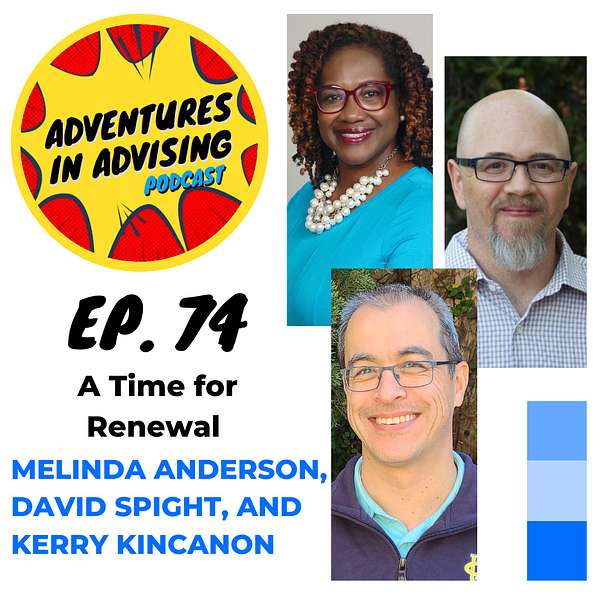
Adventures in Advising
Join Matt Markin, Ryan Scheckel, and their amazing advising guests as they unite voices from around the globe to share real stories, fresh strategies, and game-changing insights from the world of academic advising.
Whether you're new to the field or a seasoned pro, this is your space to learn, connect, and be inspired.
Adventures in Advising
A Time for Renewal - Adventures in Advising
In Episode 74 of the Adventures in Advising podcast, we're chatting about: Goals, reflection and gratitude, conference highlights, undeclared/exploratory students, advising administration, and research/scholarship!
You'll hear interviews with:
Melinda Anderson - NACADA Executive Office
David Spight - University of California, Irvine
Kerry Kincanon from Oregon State University guest hosts!
The Twitter, Instagram, Facebook and TikTok handle for the podcast is @AdvisingPodcast
Check out and bookmark the Adventures in Advising website!
Also, subscribe to our Adventures in Advising YouTube Channel!
You can find Matt on Linkedin.
Follow the podcast on your favorite podcast platform!
The Instagram, and Facebook handle for the podcast is @AdvisingPodcast
Also, subscribe to our Adventures in Advising YouTube Channel!
Connect with Matt and Ryan on LinkedIn.
Matt Markin
Hey, this is Matt Markin, and welcome to episode 74 of the Adventures and Advising podcast. In this episode, we have Melinda Anderson from the NACADA executive office and David Spight from University of California, Irvine. And this episode is guest hosted by Kerry Kincanon from Oregon State University. Here is episode 74...
Matt Markin
Hey there, and welcome to episode 74 of the podcast. There's just so much to celebrate. It's a new year. So, happy 2023. I hope you enjoyed your winter break if you did get one, and also that January can be a reset of sorts, and this is a new year, so I hope it's a productive and enjoyable year for you. And it's also time to celebrate, because this podcast, at the end of 2022 garnered over 34,000 downloads, so we're on track to reaching 35,000 downloads this month. And one last thing to celebrate, or really bittersweet, I guess, is that this is the second to last episode of the current run of the adventures and advising podcast. So please enjoy this episode. It's filled with lots of tidbits and great stories, just like all the rest. First up, we have Melinda Anderson back with us from the NACADA executive office. I can't think of a better person to have on right now than Dr. Melinda Anderson, Melinda, welcome back.
Melinda Anderson
Oh, thank you so much, Matt. It's so good to be here as always. So good to see your face and feel your energy even through the screen. So good to see you.
Matt Markin
Yeah, good to see you, too. And I think the first question we have to throw out there is, there was an email that was sent out in December. We're recording this in December, and it said, you know, it was an email that you had sent out saying that you were taking a leave from NACADA.
Melinda Anderson
You know, Matt, I'm glad that you know you've asked me this. I know a lot of people were probably surprised to receive that communication from me, but for those who have known me, have heard me speak, I'm always encouraging people to take care of themselves. We've spoken on that a lot, you know, in a couple of podcasts, about how important it is to take time to take care of yourself, especially if you're you're caring for family and and then how do you pour from an empty cup? And so I had somebody very wise say to me that sometimes it's important for us to take our own advice. And so although it was a very difficult decision to make, it was one of those that I just I just felt very led to make that decision right now, to take some time to be able to support my family, to be able to take some time to support everything that's happening with us. You know, my Thanksgiving message kind of spoke to how critical time was and how important time is, because time is the one thing you can't buy and it's the one thing that you can't get back. And so when I think about how much I do love my work, I do recognize that sometimes we need to show up for our family and different ways. So taking some time to be able to devote and pay attention to that was important. But I also feel it's important to be transparent and to communicate with those who may be depending on you or looking to you for support. So just wanting to make sure that everybody was aware. And you know, Wendy Troxel is the acting director, and so, you know, I have full support for her. I have no, you know, concerns about what's gonna happen, you know, because I'm not in the office right now. And that's what great teams do. You know, they come together in times. You know, I often tell people that, yes, I'm the Executive Director, but I don't do this work by myself, right? It the executive office staff is amazing. They come together. They work hard. You saw that with the most recent annual conference experience we had. You know, we all just come together and we do what we can to support each other, and so I'm just grateful for that team that's rallying around me right now, and that's the work that we do. Right when we see that people need support and they need time to be able to kind of manage affairs differently, we all just kind of step up and we take turns. So this is my time.
Matt Markin
Yeah, and just like you're saying with time, like, we don't get that back, and how many times throughout the day do we lie to ourselves and like, Oh, I'll do that tomorrow, or I'll take care of this. And once this project's done, it'll free up so much more time, and I'll be able to take that vacation.
Melinda Anderson
That, you're absolutely right. Yeah, and you know, if anything that we've learned coming out of the pandemic and then moving into just these precarious times in society, you know, right before Thanksgiving, so I'm home in Chesapeake, Virginia, right now, and right before Thanksgiving, there was a shooting at Walmart that took six lives. And you just have to keep thinking to yourself, I know that I don't always understand people's pain or why they show up the way that they do. These, you know, violent acts that are sometimes, you know, on the headlines, just as a headline. But then you think about the lives that have been impacted through the devastation, right? And here in Chesapeake, you know, the community came around, supported those families we've asked, not we, but my church leadership has asked Walmart, you know, to pay out the salaries of those whose lives we've lost, because you recognize that there's the residual, I mean, the the impact, right? That happens after you experience those things. So for us, it's a headline. We read it on the news, and we move forward. But you know, those families of the lives that have been impacted, they'll never forget that day, right? Their lives have been changed forever. And so then it's one of those moments where, when you come into a holiday season and you think about all the the joy and happiness some people may be feeling, but then also the sad and sorrow that a lot of people are feeling when they think about having the holidays without their loved ones. And so I think it's it is you're right. It is important to be honest with yourself about, how are you utilizing your time? What matters to you, what's important to you, what fills you up, right? And then trying to manage and cut down on the things that that don't bring you all the joy. Now I tell my dad all the time, look, sometimes you got to do the things that you don't want to do, right? So I'm not saying I don't want anybody to conflate that message. Like, you know what? You're right? Melinda, I'm out of here. Like, no, no. I'm not saying that. You know, whether it's work or relationship, right when it is? Melinda is not giving that advice today, but what I'm saying is, is that it is important for us to be thinking through and measuring our time in different ways, absolutely and just embrace the moment. You know, staying present. I think that's a lot of what I was coming to realize, like, how are you able to stay present in these moments, because once they're gone, they're gone.
Matt Markin
Now we'll just take the little snippet and then throw it out of context and be like, this is what Melinda is really saying. Just quit your job, enjoy life.
Melinda Anderson
Let's all go to, you know, another country, right and we live off of the land right now, my sister and I joke about that all the time, like, Where would we move and become expats, right? Or something like that, but, but, yeah, the holiday season, you know, as we approach it and as we go into the new year, right? Is this this idea of renewal, this idea of, well, do you have new year's resolutions? Do you do that? Do you participate in that madness.
Matt Markin
You know, we, I remember, I was talking about this last year, and it was one of those where it's, I try not to say I have the new year's resolutions. I just try to say I have goals, but I try to start them before the new year so I can try to build that into a habit.
Melinda Anderson
Right, right? You know, like it was, I'm gonna go to the gym and lose 20 pounds, right? And then, like, January 1, the gym is slammed. And then like January 18, the gym is back to normal kind of thing. Yeah, I used, I, I'm, like, you I used to participate in the madness of, like, this is my new year's resolution. And then probably, maybe five years ago, I just said, you know, this is how I want to change my life. This is how I want to move forward. These are the goals that I'm setting, and I do think of it differently and trying to make them more sustainable, right? And you're right. I do try to start before January hits, right? So then I can feel like I've got some some ownership, right? Because I've already kind of started the behaviors. So yeah, but for all those who still have you know, New Year's resolutions. Congratulations. I hope that you are holding on to those as you move forward. But it is important to think about how you want to live and experience life differently, and sometimes, if only in the New Year's spirit, you know, to do reflect on that and think through that and and come up with different directions for yourself, you know, I still applaud that, because sometimes that might be what you need in order to kind of kick start it.
Matt Markin
Oh, yeah. And I'm just trying to, you know, I'm just thinking about what you've just said since we started recording. And, you know, for me, it's, you know, we're talking about, sometimes you do need to put in that that work. And it's not always going to be, you know, sunshine and rainbows every day. And it's, we're not trying to say that's what life is going to be, but it reminds me of a Stephen Gaffney who said, like you, sometimes in life, you have to do things you don't like to do, but you should love why you're doing it, and sometimes that can help you get through in the short run, so you can eventually address those things in the long run.
Melinda Anderson
Oh, I agree. When I was young. My mom would say, you've got to do your work before you play. So you come home, you do your homework, and then you can take the time to do the things that you enjoy, right? And as I've gotten older, you're right, if you always think about it as, oh, I don't want to you know what I mean. But then you remember like this is either building strength or building energy or building like that's what's keeping me working out every morning. I do two miles every morning, and I walk. And when it got really cold outside, it was cool to do it in August and September, right? And then it got to be, you know, now we're in December, and I was just like, You're doing this because it's a way to meditate in the morning. It's a way to be one with nature. It's a way to spend some time alone and just reflect. And so those are the reasons why you do it, right? But it's still cold. Matt, I have like, two hats on, I have gloves, I have two pairs of pants, right? You know what I mean? Like, I'm, like, gearing up, you know what I mean, just to go walking outside, but you're right. It's the reason why you are are doing that work or pushing through, right? It's, it's getting sometimes, you know, getting to the other side. It's definitely worth it.
Matt Markin
I think it's definitely a mentality that that you have to, like work on each day. Because I could imagine that as as it gets colder where you're at, you can easily tell yourself, you know what? I could do this later in the morning, when it gets like two degrees warmer, or if I'm putting on these two pairs of sweatpants and jackets. Oh, this is too much work. I'll just do it later, you know, right? I would just go buy a treadmill instead and do it in the house.
Melinda Anderson
In the house, I know. That's the one thing my sister gets on me. She's like, why? I mean, just join a gym. And I'm like, oh, but to be one with nature, no. And, like I said, it was cool when it was like, August, September and October, you know, when it turns fall, and fall is my favorite season and and so, you know. But here's where the work comes in, right? Like, how do you keep consistency in spirit and energy, and for me, in truth, right? In terms of how I want to show up in the world when it is 23 or 24 degrees outside. And, you know, in Virginia, doesn't really snow until January or February. But in Kansas, it is already snowed once. So it was one of those moments where I was just like, what is happening, right? But just remembering the Midwest, that Midwest weather, you know, is a little different, shows up differently.
Matt Markin
So, that's that's why I like Southern California. So you should come back and visit sometime.
Melinda Anderson
I know you're going to throw that in there. I wasn't gonna put that out there for you. That you walking at eight o'clock in the morning, or seven in the morning is when I go. It's probably not a problem. It might be a little snippy in the air.
Matt Markin
Well, we'll, we'll still wake up in California be like, it's freezing, you know, and it's like, you know, 65 degrees.
Melinda Anderson
But, you know, when I was there for region nine, it was simply gorgeous, simply gorgeous. And you know, I often, you know, still joke with my sister about us buying a house and then, you know, renting it out one week. You know what I'm saying, so we can all afford to live there. But it was so gorgeous, so gorgeous. We had a great time tonight.
Matt Markin
And yeah, and that was earlier in 2022 at the region conferences. And I guess, speaking of 2022 and looking back on it, reflecting back on 2022 How do you feel that year went for NACADA.
Melinda Anderson
I think you know Matt, when I think about from the beginning of the year, and not necessarily just around events, right, but like the fact that we were in a brand new year. What does this look like? You know, we had amazing region conference events, and I was just really lucky and blessed to be able to participate in nine of the 10 and the the winter institutes and the summer institutes that we've had just being able to talk to membership, to talk to advising administrators, you know, professional advisors, faculty advisors, all throughout the year, thinking about the work that they're doing on their campuses, how they're showing up, how they're supporting their students, how our community is coming together to support each other. For me, when I think about all the work that we've done in the association, all the support from the members, it's humbling. It's humbling to think that you belong in a space that is moving right through a such a paradigm shift in the way that we think about higher education, how students are experiencing their education in institutions, the conversations that are not happening at executive levels, that weren't happening five years ago. Like, I always tell people like paradigm shifts. When you are going through a paradigm shift, it does not feel that way, right? You're just kind of like, okay, we used to do it like this, but now we do it like that, and we're thinking like this. Thinking like, this room, you know what I mean, and then you reflect on it, like, oh, wow, that was amazing. Look at the paradigm shift that we experienced right now. But when you're going through that shift, that's not what it feels like, you know what I mean? There's all these unanswered questions, and how do we move forward? And what does the research show, and how do we solidify these best? I mean. Promising practices. We don't say best practices anymore. You know what I mean? Like all those things. And so when I reflect on the year, it's number one. I always think how humbling it is to be in a space hearing all the work that's happening and how dedicated and supported our members, our conference participants are in terms of doing this work. It's amazing, right? The other thing that I think about is the work that we're doing to build the foundation in order for NACADA to move in the next direction. You know, when you think about how we're talking differently in our presentations, we're asking different questions when it comes to research and scholarship, when we're thinking different. You know how our NACADA leaders are thinking differently and wanting to move in different spaces. You know, we have the consulting work that's happening right now evaluating our organization, because it's been 20 years since we've had a structural change. And, you know, we our membership went from, you know, a little around 10 to like, now we're over 13. I think it was 1325. Is what it was last week, right? And so you think about how we're going to continue to grow, and how we're going to continue to transform. And for me, I feel like that's exciting, you know? I know some people, when they're on a roller coaster and it's like going down the hill, they're like, and some people are like, Yeah, I love this. And some people are like, Oh my god, I think you know what I mean. But for me, it's, it's that part of like this is so exciting, right? Because sometimes in order to create something that's new, you have to stop doing the things that you were doing in order to do the things that are new, right? It's kind of the stop, start and continue conversations that I've had a lot with the executive office. And you know, the idea that as NACADAcontinues to grow and we solidify our footprint in the marketplace, when we're having these conversations around academic advising, we're having leading voices come out. You know, we have the report in The Chronicle that comes out that said the future of academic advising, and they spoke to myself and Wendy Troxel about what is the research showing, what are promising practices? How do people need to be thinking about this work on their campuses? That's amazing. Matt, right, to find yourself in different platforms to have these conversations, I think about your podcast and how people tune in to kind of hear what's going on, you know, and and a lot of it around community is, is huge. You know, when you think about how we come together, how we're sharing and giving of ideas. I've always been very touched by how giving our community is, you know, Matt, I could call you or email you and say, hey, you know, we're thinking about building this career ladder, and what does it look like? And what do you what is going on in your campus, or we're getting ready to, you know, create a new pre professional Advising Center, you know what I mean, like, what are some thoughts? Do you have some people that I can reach out and talk to you. And we're always so generous, so generous. And when I think about how we've ended the year with the annual conference experience, and Matt, you were amazing, you and Leah, leading that group just really bringing us back, right? You know, Cincinnati was amazing, but we knew that we were coming off of, you know, the pandemic experience and so coming into this annual conference experience, you know, having over 3000 people join us in person, having over 650 joining us virtually, you know, so when we think about virtual programming in relationship to our in person, I mean all those things are being defined. And so again, I just want to thank you and all your hard work and and leading that effort and that committee, they were so amazing. You know, just walking around the convention center and, you know, I had never been to Portland before, so all of it was brand new and exciting. And then seeing so many people wanting to come and connect and share, it was just very powerful moment for the association, the way that we showed up and showed out.
Matt Markin
I mean, because it really did feel like Nakata is back, you know, because when we're talking about, you know, Cincinnati, yes, so much was unknown in 2021 and then when the decision was made, okay, we're gonna have this conference in Cincinnati, then you probably got a lot of questions like, Are you sure you want to do that? Can it be safe? And it was proven that you could make it safe. But there were still so many questions that then rolled into 2022, and it's like, should we have region conferences? Will people, you know, show up to it? Which they did, but then you still had, you know, a lot of institutions that budgetary issues. And then, you know, is it still safe to send people to conferences? And I think as we got into the summer, then we started seeing the uptick in the number of participants that were registered for Portland. And then it was like, Okay, this actually seems like this is coming back to, like, pre pandemic levels. And then you saw so many people that that showed up virtually, in person, and, yeah, it was definitely like, just being able to, you never know who's going to be there, and then just right, stand there, look around and be like, Wow. Okay, we actually are putting on this conference. This is pretty amazing.
Melinda Anderson
And you know, there were so many people that, you know, I would hear conversations in the hallway of people saying, I. Yeah, I have not seen you in over three years, or I haven't seen you in four years. You know what I mean? Because you're right. You don't know who's coming. You don't know who showed up, and not everybody can make it to Cincinnati. You're absolutely right about, like, you know, institutional impacts around budget, not that people still didn't want to participate in professional development, but, you know, like it, you know, the is it safe? You know, do we have the funding to go our enrollments are dropping. What does that look like in order for us to be supported? But whoa, Matt, you were right. They showed up in Portland. And I, you know, know that that good energy is going to continue as we go into the region conference experiences, right? And, you know, and I love the fact that three regions are coming together, right to do the one in Vegas. And so when I think about, just like I said, collaboration, coming together, creating experiences, you know, we're also shifting into, like, different, you know, markets. You know, Region One is going to be in Boston, right? And so I know normally people, when they think about region experiences, you know, you know, like, What city is it going to be located, and everything like that, right? But what I love about the region conference experience is that it still draws people regardless of where the location is going to be. But I love seeing the innovation and new ideas, right? You know, if we're in a larger market, do we draw people who maybe are not members yet, but then it's accessible so they can get there, right? When I think about three regions coming together and then pulling their resources, and then pulling folks from all across those regions, you know what I mean? Just kind of thinking about, you know, talking to somebody from a school that you might not have normally seen, right, only at an annual conference, but then you go to a region conference, and you still get that same level of experience and diversity of thought and everything and and so I'm just excited, you know, for the winter Institute's, you know, administrative Institute, the assessment Institute, and then we have the Summer Institute, that's going to be happening in June, and then we'll be in Orlando, Florida, for the annual conference, right? I'm telling you, Matt, it's like, I told my daughter when she first went to school, I was like, you're going to blink, and your semester is going to feel like this, right? You're going to wake up. Going to wake up, you're going to be a sophomore, you're going to close your eyes, you're going to wake up, you're going to be a junior. And she did not believe me, right? And then she calls me and she's like, Mom, you're right. Right after Thanksgiving, it's like one week of classes, and you're straight into exams. But that's what it feels like sometimes with our NACADA events, you know, we we celebrate those moments, we celebrate the energy that went into the effort, you know, and then people are excited about the next event, right? And that's what I do love about our membership and and those who are wanting to come and participate in our experiences, like, if I can't get to one, then I have the opportunity to go to another. And we've done that intentionally, right? Because these conversations need to keep going this energy building community and all needs to keep moving forward. And so just very excited about what 2023 is going to bring for us.
Matt Markin
Well, it's perfect timing that you mentioned Orlando, so the October 2023 annual conference. So we're recording this on December 13. Just a couple of minutes ago, there was an email that got sent out from talking about the annual conference, proposals are open. So if you're listening to this in January, let's say you have until February 23 that's the deadline to submit proposals for the Orlando conference.
Melinda Anderson
Conference, yes. So please submit. You know, connect with your colleagues. Think about sessions that you could do together, you know, definitely, you know, I want to start talking to, you know, our senior level administrators out there too, you know, those key or new key positions that are going to be definitely, I think, are not going anywhere, right when you think about, how do we lead this work at senior level administrative positioning at your institutions, And so asking them to come in and submit presentations as well, right? So when we think about, you know, how are leaders thinking about guiding and moving institutions together? But then also, what is the promising practices and how we're connecting and supporting our students? And then I'm always encouraging people to think about writing for NACADA. You know what? Research, scholarship, but you know, what are your thoughts, things that you are curious and interested in doing? You know, there's a space for that here with us at NACADA. So just really encouraging people to think, you know, what do you want to do professionally in terms of building a new skill set, or things that you want to share with others? You know, like I said, we are giving and receiving community. And so, yes, you know, we know that annual conferences are an opportunity to kind of gather with a lot of people, and so really encouraging people to consider submitting a proposal for annual conference in Florida.
Matt Markin
And then kind of going back to Portland, you know, you mentioned some of the like conversations that you had, but any favorite memories or highlights from the Portland conference?
Melinda Anderson
Oh, wow. Okay, so this question might get me in trouble, but I'm going to do my best.
Melinda Anderson
Well, no, no, because I think about, you know, we had a chance to celebrate Charlie, right? We had an opportunity because we didn't do it in Cincinnati, because he was still, you know, phasing out of, you know, in retirement with Nakata. But then, you know, he had fully retired, and so just an opportunity to celebrate him and to acknowledge his work, his his time, his dedication to the association, his energy. It just felt really good to be able to to do that the way that we would have wanted to right the keynote with Megan. I just want to make sure that okay, I'm not messing up her name with Megan. Megan, Red Shirt-Shaw. Oh my gosh, powerful, right? You know. And I remember when I was reading her any Novation at the end, yes, exactly, you know, just reading her bio and thinking about the work that she's been doing with indigenous populations. And, oh my gosh, that was so good, you know. So you kind of like going to the conference with this good energy. But favorite memories, of course, are, you know, the ones that you don't necessarily expect, right? Somebody that you haven't seen in a really long time. I Amy Streit is one of my, well, we worked together at William and Mary. She was a GA and and then she's like, doing all these amazing things at James Madison. You know what I mean? So it was like, you know, people that you didn't expect to see people you were hoping to see, you know. So it was really good, you know, just to connect with the people I hadn't seen in a really long time. And of course, you know, being with the executive office staff, you know. You know, we work so hard, you know what I mean, to put on a good conference experience and stuff like that. And so just, you know, seeing how we come together and we work hard together as a team and support each other. You know, I always do, like, kind of those internal moments as well, when I think about a conference experience celebrating, you know, 15 years of ELP and so that's always wonderful, you know, to just kind of recognize the work that people have done, the mentorship, the connections. You know, I was an ELP, and then as a mentee, as a men, as, yes, as a mentee, and then as a mentor later, and so just those special moments, you know, in terms of how you've, you know you you know how you've known somebody for a while, and then you're like, how did I meet you? You You know what I mean, like, what was that like? Was I just sit next to you in a session and we started talking? Or, you know, were we in EOP? You know what I mean? But we weren't necessarily paired up, but we were in the same class. Like, it was just amazing, you know, our award ceremony, you know, just recognizing the great talent and that we have in the association and and so being at the awards program was just pretty special, and I do enjoy, you know, connecting with the board and council. You know, they have great ideas. They are passionate about the association. They want to see it continue to grow with and think differently about how we're showing up, right in terms of leading the conversation around academic advising, I know, right? I told you I was like, Oh, I don't want to mess up. But now my mind is running with, like, all the things that I enjoyed, you know, because I think about, like, the Nakata leaders. We had everybody come in and and we did, like, a day when we were able to connect with with everybody, and talk a little bit about the state of, you know, the association, where's it going? Some some some conversations in terms of, what are their next steps in leading in the association. And so I always just love just seeing my friends, right? I wasn't always in this role as executive director and and so coming in from serving in a region to being a region two chair, right? And, you know, and Matt, you know about that, like, when you are in a chair of a region, you know, you're thinking about things differently. You're connecting people differently, and then moving to the council, and then eventually the board, you know, it was just kind of a nice way to think about my development, my leadership development, really in Nakata. And so you're just seeing things differently, and certain things are touching your heart in certain ways, where maybe in other positions, I wouldn't have never seen the connections in that way. But then, and it's just sometimes it's good to sit down and have a drink or have a meal. Share a meal with your friends, right? And that's one of the beautiful parts of when, you know, the conferencing is kind of done, you know, and then being able to kind of wind down into, you know, happy hour, into to dinner time. And so those those moments were special. I sat with some friends from region two that are near and dear to my heart. And it's one of those things where we're all Nakata members, and we happen to belong to certain regions, right? But I just remember when I first came into this association, those were some of the first friends and colleagues that were so supportive and helping me grow and think differently about my role as an advising administrator. Year. So things like that, you know, they're just, they're just priceless. They're, they're irreplaceable too. And so it was just, it was just really good to have that, that level of experience. So those are some of my best memories. I know I've given you like 15 of them, but I was there for like almost a week. So it's a lot to kind of roll through, but I'm just really excited about what's next for us, because I have seen how amazing it can be, right? And so that's the kind of energy that I want us to take into the next year.
Matt Markin
Yeah, I mean, I was there for a week as well, and it's, I feel like it just it flew by and but it's just like you're talking about, like, depending on what role you have, like, you see things from these different perspectives. And there are moments I literally just either setting or standing, and we're just like, look and just kind of take it in. And then seeing conversations over here. And then then it's kind of looking like, oh, yeah, do I need to take care of anything? Are there any fires that need to be put out? And then, as long as no one knows about those fires, then, you know, that's what's most important. You hide them, what you can. But you're also like the little things like, Okay, you're having this conversation with this person, or you go to this session, or whatever it might be, but you're absolutely right. It is those little things that stand out, getting to be a conference co chair, and, you know, just getting to work with this planning committee that seriously just came together, you know, and you just see the magic, and you see kind of how their personalities all gel together, and everyone just worked as one unit. Wherever needed someone needed to be, they took care of it, and they all had smiles on their faces.
Melinda Anderson
They did. Yeah. Let me tell you, every time I walk by the booth, it was like, How can I help? What can I do? How can I support you? And even though I know that you were probably running around roller skates on just like I was, it was like ships passing in the night, like, oh my god, everything's good, okay, great. Just your energy, your your your passion, your commitment to NACADA, but then also that experience, right? Like, sometimes things can be, oh my gosh, there's, you know, all the details, right? And dotting the I's and crossing the t's or something doesn't go as well as we had planned, right? But this is the beautiful part. Just like you said, I know what it was supposed to look like, but you didn't know it was supposed to look like, and you still loved it, right? And so then it's about letting go of some of the things that we can't control. So I just think that sometimes these are just great life lessons that we learn along the way, too.
Matt Markin
Oh no, absolutely I know for me, aside from, like, the planning committee, which definitely was a highlight for me, is just to just see them work, also working with Farrah and Dana from the EO. And that's kind of how I gaged each morning was how serious Farah was, or if she had a smile or a little smirk on her face, and I knew, Okay, everything's going pretty well,
Melinda Anderson
No, you're absolutely right. Dana and Farrah, they show up in tremendous ways. When you think about all the nuances, right, the behind the scenes, stuff that you know now that you, you know, you kind of walk that path with them, you know, it's a lot, you know, and we, I can never not say thank you enough to to them, to other EO staff members that lead events, you know, at that level, because there's just a lot going on. But I always just want to thank leadership like you and Leah, your planning committee, that all do come together, you know, because it is a team effort. You know what? I mean, not one person could do that work by themselves. And I think that Portland people were really excited. They were glad to be there. They're, you know, just taking advantage of being in that space, you know, and so leading that effort. I mean, three, over 3000 you know, that's a pretty you know, when you think about all the logistics that kind of come with that number, it was pretty big, but you guys did a tremendous job. So thank you again.
Matt Markin
Yeah, appreciate that. And I think my last highlight, I would say, is getting to meet Jenny Bloom in person. Like, I talked about the podcast before, and it's something where I get Cincinnati, I was so looking forward to meeting her. I'm like, Yeah, friends with her on Facebook. You know, we've chatted through email before. And then now, you know, and here it's like, okay, I get to go, go and see her in person. I saw her, but every time I would try to go over to her, she would either be in a conversation or someone who would beat me to her and start having talking to her. And I'm like, Okay, I guess next year. And then, you know, and then Jenny been a guest on the podcast, but then a guest host on the podcast. I'm like, I have to meet Jenny at some you have to meet her. And so I'm in the hotel lobby across from the convention center, and then I look outside and there's someone that's running, you know, jogging down the street. I'm like, I think that's Jenny Bloom. Okay, there's another missed opportunity. Yeah. Yes, and then a couple hours later, about to head over to go. It was like the when registration opened up on it was like on a Saturday. So I'm going to head down to the come down, back down from the hotel, get to the lobby, start about to go across the street. And in the lobby, there's Jenny bloom talking. I'm like, Just my luck. So I said, You know what? I'm just gonna go interrupt this conversation. No, I'm sorry for interrupting the conversation. Yeah, but yeah, I was like, I I have to say hi, give you a hug. And the one thing is, I got to talk chat with her and her husband, and then I didn't even take a picture, so, like, there's no proof.
Melinda Anderson
Oh my gosh, Matt, no, not you not taking a picture. Oh, you've got to document that. But no, she's she's wonderful. She's so kind and so generous. I'm glad that you know, at least you were just like, You know what? No, I'm tired of just letting these things go, because you know that, like you said, it moves so quickly. You wake up, right? And you're just like, oh, this is day three of the conference. You know what I mean? If I don't do it now, it's the now or never kind of situation. And so I'm glad, I'm glad that you were able to connect with her.
Matt Markin
You know, we talked about 2022 talking about, you know, your thoughts on, on how things went for Nakata, but like for you, you know, you in 2022 you're finishing up year one, starting and going into year two. So I guess for you, how, how has that been in terms of you going finishing out your first year as executive director and then rolling into your second year?
Melinda Anderson
Oh sure, you know, it was funny. That's the question I got asked a lot when I did happen to walk down the hallway and it looked like I wasn't roller skating. You know what I mean? Like I was walking, not like walking like, you know, you do the conference walk when you're like, I gotta get to this room. Oh yeah, it's like, I'm on I'm on a mission right now, exactly. So for those who are not watching the video, I was moving my shoulders with a quick and urgent pace. So it was good, I think, for, you know, when I think about people asking me that question, you know, just to kind of reflect in those moments, I've learned so much, is kind of how I always would start, you know, answering that question. I've learned a lot about association management. I've learned a lot about budget and finances. I've learned a lot about, you know, the politics and governance, you know, leading it from a staff level, right? And not necessarily as being somebody who served on the board or council. And so there's different things that you consider, different factors you think about. But the one thing I was pleasantly surprised to realize is that the heart of the work that we all do is still present. You know, I think Nakata is unique in the work that we do with our volunteers and our leaders, that our hearts are full and they're present. And people mean, well, I remember when I first started in this association, and people would be like, Oh, I'm just waiting for the other shoe to drop. You know, these people really aren't that in aren't that nice. These people really aren't that and I'm like, Hmm, you know. And then it's like, year five, year six, year you know, because I've been in Nakata since 2009 and so then you start thinking yourself like, no, no, this is it. If the shoe was going to drop, it would have always dropped. And so I think that learning from, you know, like, from, like, a fiduciary perspective. You know what I mean? I think it's pretty big. I think a lot of us, when we work on campuses, you know, this is what I always tell people, you know, the provost gives you $5 you try to spend $5 because if you spend 430 they're going to ask for the 70 cents back, right? You know what I mean, like, when I think about how finances kind of operate on the campus. But when you think about, you know, a nonprofit association, when you think about our status and everything like that, you know, generating revenue, thinking about how we're managing expensive, like we were not different in terms of not having an impact from covid, right? Like campuses were having an impact, other associations were having an impact, you know, in terms of, you know, just managing, you know, through, you know, whether it was losing members or whether it was, you know, people weren't necessarily attending events and things of that nature. You know, Nakata was no different, you know. But I think learning what that means. How do we think about the work that we do, diversifying our programming and our services, you know, offering more things online. How are we connecting or communicating or advertising? You know, the opportunities we started, you know, excellence in academic advising that. You know, we've redesigned that program from two years to one year because, you know, a lot of schools are like, I still need to do this work, but I can't. I might not have to year to be able to do this work. Leadership is changing, so a provost could be here one year and be gone the next. When you think about support on your particular campus, you know, I remember reading a report and they were saying that presidents, I think it's like around an average of five years time span. And you know, them spending time on campus. So when you think about, how effectively can we do work, right, and how do we do it efficiently? How do we work smarter, not harder, you know, so our excellence in academic advising program redesign is is, is a testament to that right. People need to do this work. They don't have all the time in the world to be able to get this done anymore, because they need decisions to be made sooner rather than later. We had our advising Outcomes Survey, you know, launch, and so when you think about that, in comparison to like nesi or SESI, you know, being able to have this survey provide real information to you about how you're going to steer your advising program and services forward. That's huge for us, right? You know what I mean in terms of the things that we're doing that speak to the field, but still also paying attention to our events and the community development and leadership development, when you think about some of the things that the membership and retention committee when they start looking at uniquely members experiences in NACADA and creating modules online for leadership development and support within the association. So we've learned a lot about who we want to be, and I've learned a lot about what is required in order to make those things happen. So that's probably more of a detailed answer than I went into at the conference. Was like, I'm learning a lot. You know what I mean? Like, I'm busy, but, you know, it's good, but I think sometimes it's good to be in these spaces and to be reflective of Matt and to be honest about like, there's a lot of things that any professional still needs to learn in order to grow and move forward. And so I've just had the privilege, you know, in the past year and a half to be able to be at the helm in such a way that, you know, I'm being stretched and grown and and wanting to do good work for our association, to be here another 40, 5060, years, right? You know, as we are coming up on, you know, celebrating 45 on the road to 50. You know, when you think about how old our association is. And so I just feel good about where we are and the transitions that we're making. Because, like I said, in that paradigm shift, you may not feel like this is going to be good, but I know that it is going to be good for us to be sustained onward in the future.
Matt Markin
And as we end this interview, any message that I'll leave this time for you, like we've done many times on this podcast, anything that you want to say last messages to to listeners.
Melinda Anderson
So Oh, I do want to give a shout out to my mom. All right, yes, I think about like holiday traditions before we started recording, you know, we talked a little bit about my little Black Santa back here. My mom started collecting them when we were younger, and so my husband's continued that with giving me a Santa each year. So just want to shout out to my mom, because when I think about my final message to everybody, and you know, Matt, I want to thank you for you know, just your generosity and providing this platform for others and asking me to be a part of of this experience, because I know a lot of people listen and and they're inspired by the message that you're bringing them. So I just want to thank you. I'm just grateful to you for allowing me to have this space and time when I think about how we move out of this year into the next year, I know that a lot of people might be, you know, moving out of this year and coming into next year with either broken hearts, right, or exhaustion, or, you know, just, you know, feeling a little bit lost as we're kind of winding down this year just because of everything that we've experienced. But my message of hope when we think about how we're coming into the next year is to remember that not everything is permanent in our minds, right? Like when you think about how you're wanting to grow and change and to move differently or to think differently, we have the ability to change a lot of the things that we think that we can't. And so I think it's about building community. It's about networking. It's about just remembering that you have the capacity to change and to operate differently in all of our spaces. And I'm not just talking about work, but about our lives. That's the message of hope that we bring to our students. Every day, I remember sitting there talking to my students like, you know what you are not your grades. You know you are not you know you're indecision. You know you are not your your background or your circumstances that have brought you to this point where you know you're seeking help and support and guidance, right? We do that work every day, Matt, but we don't give that to ourselves. We really don't. We don't give ourselves the grace that we give others, and so my encouragement would be for people to give that grace to themselves. You know, we're not meant to be a. Alone in this work, in life, you know, and so making those connections, holding on to our friends and our community, our families, however, that shows up for you, just remembering that that's what's going to hold us together in those times and those spaces where we're fatigued. But the hope that I hope that I hope people, I hope that hope, sorry, the hope that I would want people to carry forward is the fact that we are supposed to continue to grow and evolve. We're supposed to be thinking differently. You know, I always told myself, if I'm the same person that I was last year, then something went horribly wrong. So sometimes we're in those fires because they're forging us to be stronger. You know, I remember reading something the other day, and it was talking about, you know, diamonds are formed under pressure. And I think sometimes we don't want to realize that you need pressure to make diamonds, right. Sometimes we just want things to be well. But it's in those moments is when you're really forging your strength and your energy to be sustained as you move forward into the next directions. And so going into 2023 I am hopeful. I am excited. The future looks bright, and I hope to take this time that I mentioned earlier to renew my strength and energy to show up differently for my family and well, for myself, right? I'm working on that self care, self care showing up differently for myself and then for my family and then ultimately, for for my profession.
Matt Markin
And I just want to say, like, I getting to know you over these last couple of years. I mean, I know, I think the first time we met was recording for the Emerging Leaders Program for a promotion for that, and I was just in awe of talking to you. And then, you know, then we interviewed you for the podcast when, when you won the the election for becoming a counter president, and then a couple weeks later, like, Nope, we need to update this interview, because now DACA is the Neville and is the Executive Director, so it's kind of like changes happen sometimes within a short period of time, and it's like, how you roll with it, and then just having to have this opportunity of getting to chat with you, having you on multiple episodes of the podcast talking about conferences, you being our keynote at the region nine Cal can conference back in spring, and just seeing how you kind of go in stride with everything. And yes please, it's following your advice that you give to others, you know, but just the work you've put in, and just again, me just observing over the last couple years, it's it's been an honor getting to know you and working with you, and I hope I get to continue to work with you and bounce ideas and see where life takes us and academic advising in the future.
Melinda Anderson
Absolutely, and I share the same admiration for you just meeting you and thinking about, wow, you know he's, he's, he's on to something about thinking differently about how we're sharing and communicating his messages and and how narratives of stories, you know, people's lives, right, and how they show up and teach us things. And so you've just done a brilliant job in curating that and those messages for us. And I know that the podcast is not going to be as frequently produced. I'll put it that way. I'm not going to say that it's stopping, because I'm like, no, no, absolutely not. But when I think about that decision that you made, it's powerful, right? It's the same decision, you know, or choices that you know, I've had to ask myself, you know. And so I just know that this work will continue. It may show up differently, but Right? That's the point of evolution, right? That's why we continue to evolve and to grow. And so then again, just thanking you for your work and having giving me an opportunity to be here and to share this message with everybody, I think when one of my AAT articles, I talked about how hope springs eternal, and that's exactly where you know I have to lay my hat these days.
Matt Markin
So, yeah, and kind of listen to you since we started recording like the one quote that keeps popping up in my head, and this is where I'm a nerd, I'm a Trekkie, Star Trek. So Captain jolly Picard said that, you know, time is a companion that goes with us on the journey and reminds us to cherish every moment, because they may never come again. So what we leave behind is not as important as how we've lived.
Melinda Anderson
Oh, I love that. That's a beautiful way to end this session.
Matt Markin
As always, Melinda, thank you so much for being on the podcast.
Melinda Anderson
And thank you Matt for having me.
Matt Markin
Thank you, Matt, you, Melinda, it's been such a pleasure having you on the podcast as a guest and multi time guest host. You have so much insight, and I'm sure we'll have more projects planned together this year. And next up, we have Kerry Kincanon from Oregon State University back with us as a guest host to interview David Spight from UC Irvine, Kerry, welcome back.
Kerry Kincanon
Oh, thanks, Matt. So glad to be here again.
Matt Markin
And we're recording this in early December, but this is being posted in January 2023, so I'll also say Happy New Year as well. And so if you want to know more about Kerry, check out episode 55 of the podcast back in March of 2022, titled, New Ways of Thinking. And you can also check out episode 68 from October 2022. Titled, looking beyond your office, where Kerry guest hosts and interviews Clay Schwenn. So Kerry is back as a guest host. And Kerry, I turn it over to you.
Kerry Kincanon
Thanks so much, Matt. And what a privilege to be here again, to be in this space, to talk about academic advising, and especially to be here as adventures in advising kind of winds down. I know we're coming to the end of this amazing experience, so I just want to say up top, thanks so much, Matt, for the work that you've done with this wonderful podcast. I think you've really done a great deal to enhance and advance the work of academic advisors. So appreciate that. It is my honor today to be here to talk with Dr. David Spight that and so let me just start by introducing you to David. Dr. Spight began his career assisting undecided students at Colorado State University in 2008 he was named the Assistant Dean for Academic Advising and Career counseling in the School of Undergraduate Studies at the University of Texas at Austin, and was tasked with developing a new center for a new academic unit aimed at helping students explore majors. David has been highly involved in the cada the global community for academic advising, for you know, nationally and internationally. And he served as chair of the commission on undecided exploratory students, as a member of the Council, as a member of the board, as vice president, and most recently as president in 2015 and 16. Spite has presented and published articles on advising undecided students, first generation students, assessment of advising and integrating academic and career advising. David is currently the Director of Undergraduate undeclared advising at University of California Irvine, and also serves on the faculty in the College of Education at Cal State Fullerton. David is a member of the editorial board for the Journal of college student development. David earned his doctorate in higher education, Doctorate of Education and higher ed administration from the University of Alabama. So I again, I'm just really privileged to be able to talk with David. I'll set a little context here for our relationship, which goes, goes back a ways in terms of the shared connection around working with undecided, exploring students. And so I think we're going to dig deep into that. I guess I'll put this out as a cautionary caution to listeners today that this will include a healthy volume of nerding out about advising undecided exploring students. But before we get to that, let me just say, Welcome David. Appreciate you being here.
David Spight
Yeah, I appreciate the opportunity to chat. It's always fun to chat with you here.
Kerry Kincanon
Awesome, great. So before we get to the undecided exploratory stuff, I wonder if you might talk about your own undergraduate academic journey and the build that you've had towards this career as a practitioner and a leader in academic advising. I know you're a first generation student. I know that's that's important, and I'm guessing you probably would have done this anyway, but say more about how being first gen has shaped your journey and has played a part in your career as an educator.
David Spight
Yeah, wow. You know the I think the biggest irony about the work that that we do, working with students who are, you know, undecided exploratory, is that I was never undecided or exploratory as a student, right? I I had this intention of going to college to be a high school history teacher, and I think part of that was because I think when you're first gen you don't know all the different possibilities that are out there for career fields. So there's a certain number of careers you think about and and for me, it wasn't, I wasn't that history major that could tell you all the dates for events and things, but I could tell you the stories, right? It was those stories. And I think so I wanted to go as far from home as I could get, where I could get it paid for. And I managed to get a scholarship at this place that used to be called northeast Missouri State University. And by the time I graduated, they changed the name to Truman State University, right? I think our graduating class, we have, we're the only class with both University names on our degrees, right? But I went there because they gave me some money and that was going to get me far from home to try something different. What I didn't know was. Was this thing called a FAFSA, right? That had never really been explained to me, and so I never filled one out as an undergrad. And in hindsight, that was both, I think, a big driver for why I went after some of the experiences I did in college, but it was also probably why I didn't have enough money for college a lot of the time, right? So, I mean, I went there, and I was lucky in that I went to such a small school that there were lots of folks there that were there to support you, and so I had a great kind of support network that helped me figure out, oh, there's questions I don't know I should be asking, right? There are things I don't know that I should know, but the fact that I didn't know about a FAFSA and the fact that I had such supportive folks is what got me into being an RA myself. I thought, Oh, this will help pay for college, right? I was, I was the second. I'm still the second, I guess the second of four kids, right? And I knew that my older brother was still going to be in college. The next year, my sister was coming. The year after that, my younger brother was coming, and there was no way I thought my parents could afford four kids in college. So, so I went after this ra job, in part to do that, and that led me to actually getting involved in higher ed. It's what opened these doors, to seeing that, oh, there are all these different career possibilities, right? And so it's kind of funny not having filled out a FAFSA in some level because I was first gen is what led to that, but I also think it's it would it drives a lot of where I start with the practice of advising right. It's how do I make sure I understand who the student is? What do they know? What do they not know? What do they need to know? Who are they where do they think they want to go? And why? Right? So much of that comes from that experience that I had of not having all the answers and not knowing all those things. And so I think, I think that's a big part of how it shaped, kind of my journey.
Kerry Kincanon
That's so interesting. You know, I talk about my experience often with and I'm came from, I was pretty high context for understanding school. I mean, both my parents were college educated, and siblings I went to college and things like that. And even then, I still managed to screw some things up around the way. And, you know, not know things, and I think about that as well. You know, someone who had as much contact as context as I did can miss the mark on things. Imagine, you know, for first gen, you know, students who don't have that prior knowledge, there's so much that I'm with you where you you have to work off the the assumption that folks need to be informed. And right, yeah, yeah, good. All right. Well, as I said, up top, you and I have both centered a lot of our professional work on working with undecided, exploratory students. And you know, I definitely consider you to be a leading NACADA voice for this population. So let's get into your early days of working at Colorado State. Tell me about the spite as champion of undecided students. Origin Story, you know, how did you come by this work? Who are your mentors, and how did your passion for working with this group evolve and develop.
David Spight
When you describe it that way, origin story, it makes me think of like, like the MCU. There's the the NACADA advising universe, right? And it's got its own heroes and anti heroes and villains, and folks later can decide which of those I am, but that's what I think of when you say origin story, like, what was the accident that led me to what I actually that's a good way to put it right. The accident was I had been working as a dorm director, a Residence Hall Director. That's where I thought my career is going to go, and I've been doing it for like, four years. When I woke up one day and I was like, you know, I really like helping students. I don't like living down the hallway from them, and I didn't know what I was going to do for a career, so I took a job as an advisor back home in Colorado, at Colorado State. And I thought, Oh, this will be a fun job until I figure out what I'm going to do with my life, right? So it was purely an accident to take the job in advising. And I got there and I and I got this training session that was, it was basically a half hour training about how do you work with undecided students. And there was some value to it, but the gist of it was, you're going to help students find a major. And so then I found myself saying, well, that doesn't really help me understand what it is I'm supposed to do, right? Like, where do I start? And so I don't know that there was a person who was a like a mentor that was there where I could bounce ideas off of a lot, but it was, it was what I read, right? So I think of my mentors as the people who and I tried to read everything I could get my hands on related to undeclared students. And it's kind of the basis for where my understanding is right. But the folks who I would say, kind of guided me through their their writing were folks like Virginia Gordon and, you know, Tom grits wrote a bunch of things that early on in my career, played a role in how I understood how to work with undeclared students. And so I think it was a lot of that. And so I spent. Spent, you know, three years at Caro state trying things out, and I was blessed to have supervisors that were like, Yeah, try whatever, right? And there were so many things that I tried, from reading in the literature that didn't work. And I was like, Well, I'm not going to do that again. Let's try something different, right? And through some trial and error, I started to find some things that I thought, well, this works and this doesn't, and I think that's one of the things that I missed out on, was that that personal mentor I could go back and forth with right during that time, and I don't know why that is. I think at the time, maybe there weren't a lot of folks doing what we do in the way that we do right? So I think as I got more and more into it as I moved into the field, more, I think it was the conversations with folks like you, with Tara at Cincinnati, with Brody, right, some other folks who do what we do, those conversations are kind of what filled the gaps for me in that mentoring piece, And it's probably part of why I see the world the way I do right, in terms of working with undeclared students. So, you know, my origin story was really an accident, right? It was, I fell into it, and then, you know, six months into it, I got to go, who gets to do this when there's six months on the job? I got to go to a Nakata Summer Institute. Wow. Wow. And it was at that point that I actually started to understand what advising was. Was at that Institute, and met some amazing folks, both on the faculty and in some of the groups. And I think it was at that event that I finally realized I was like, I don't have to figure out what I'm going to do for the rest of my life, because this is what I'm supposed to do, right? And it ties back to my major, right? I love stories, so now I get to talk to students about who they're, who they are, right, what their story has been, and what they want their story to be as they write it, moving forward. And so I think that's, that's it really connected with me on so many levels, but especially when I got to go to that Institute.
Kerry Kincanon
What a gift to have that early in the career. Yeah, you know, that's almost, in some ways, I had the fortune of going to a summer institute, and I just think about almost like graduate school. You know, graduate school just so much, so many, so much wisdom, and so many great teachers who were there. So that's, that's awesome, you know, I think our first interactions came after you had moved into your role at University of Texas in Austin. And I was always, you know, sitting where I was sitting. I was always really impressed with the scale of your program there, and some of the cool things that you did there, the tech resources, like the UT way finder, where, if people haven't had a chance to ever look at that such a such a compelling website for exploring students. And then even some of the organizational changes that you were able to implement while there to kind of integrate the Academic Advising and Career Counseling pieces in service of exploration. Can you talk a little bit more about your time at UT and some of your experiences in leadership and organizational change there?
David Spight
You know, UT was such a I have such fond memories of the I spent 12 years there. It was such a great place to work. Not that it didn't have its complications, its politics, its challenges, but I think it was a place where, and I think it still is for the most part, where it was just kind of understood professional development wasn't just this added benefit you got. It was an expectation of advisors, right? There was a giant community of advisors there. And I think when you come into an institution that sees the importance of advising like that, there's so much more you get to do, right? And there's a lot of resources with it, but the thing I got to do there was create that office, right? And who gets to do that very often? And you know, it was interesting is much like my training when I started at CSU, where there wasn't a lot of detail, when I got the position to create this new office, my boss at the time was a dean from the classics. He was a classics faculty member, and I remember I started, and the first day, he handed me a packet with recommendations that have been written about. How do you start an advising office? And then he went on vacation for three weeks and expected me to have it all sorted out, right? I had a budget, and that was it. Well, this report had questions that I had responded to, so it was essentially he had given me my own work right, as a guide, so I had no real framework to start from. And the big question was, how are we going to show we're successful right in creating this new office? And so nobody had an answer. So when you get to make that question up, you get to come up with the answers to that question. Suddenly you get to create something. That is exactly what you're hoping it will be, right? And so I was blessed to get to do this, and they had only planned on us having maybe three staff, but by the time I left, we had 18, right? We were growing every year, but we had built it based on this idea of assessment being this tool to help tell our story right again. It goes back to those stories, right? And so we're able to show, kind of the effects of doing it. And at the same time, I started at a time when there was money for technology, right? So this way finder thing we had money for, right? So we paid for some outside folks to come in and just build it. And I learned a lot, I think, the hard way there about, how do you get parts of campus who aren't really interested in working with you to collaborate with you? Right? That was a big part of that. Tech piece was, how do you get all the colleges to be involved? But the assessment piece was a big part of it. And then, you know, I built this center. I thought it was ready to go. You know, it was time to now just enjoy it. And that's when the Dean decided to take the Career Exploration center out of Student Affairs, and he wanted to smash it into our office. Wanted to make it one big office. And that's something I don't think that we get taught how to do, right? If you get two cultures now, and inevitably, one culture thinks the other cultures come in to conquer and take over, right? So how do you bring those two together? It was that that drove thinking about the organizational structure in a different way, right? So I had to figure out, how do I separate these two cultures, even though I had built one that I was really happy with, right? But that necessitated creating these teams where we put career counselors and advisors together and assign students to that team, right? So now a student had an assigned advisor and assigned career counselor who sitting next door to each other in the office, and it became about, what's the team for the students, right? So then we started to pull in things like, Oh, the Learning Center has these specialists assigned to us. Well, okay, so now you've got a team that has a specialist assigned to you, an advisor and a career counselor, right? And then we had a program with that had been designed to mentor first gen and underrepresented students. Well, we assigned all the students that a professional mentor had in that office to the same advisor, learning specialist and career counselor, right? So now you're presenting to the students a whole different model of support, as opposed to your assigned advisor. And so that was kind of the experience at Texas, was I had this flexibility to do that because nobody knew what my job was supposed to be, and nobody knew how, how are we going to show we were successful?
Kerry Kincanon
I think that's that's really interesting at a school that size, to have be able to, you know, create almost like a population health type thing, right, where you got attention to the nuances of the student experience within their reach, and sort of a high level of transparency for them on that. I mean, talk about supporting first gen students, if you could just make sure that they know who their advisor is and who they can go to for career questions and who they can go for affinity based questions about their experience. That's, that's, that's really amazing. That's really cool.
David Spight
Yeah, well, you know, I was lucky. I had a great the dean that came in part way through my time, there was great about letting us try these things, reorganizing and restructuring, kind of how we supported the students. So, you know, a lot of that goes to him, giving us the freedom to do that.
Kerry Kincanon
Yeah, so one of the significant pieces to come from your work at UT and then your doctoral work at at Alabama is the research that you did on undeclared students and persistence. And so I just direct listeners who haven't had a chance read David's, you know, important 2020, Nakata journal article. It's called early declaration of the college major and its relationship to persistence. And then you had a subsequent article in the Journal of college student retention, undeclared versus declared, who is more likely to graduate? There's a lot there in both articles, and I want to be careful not to reduce it. But can you nutshell a bit your findings and and, you know, talk maybe a little bit about the response you've gotten for that from those who have actually engaged with your work.
David Spight
I think there's, I think, an easy way to maybe reduce it, because there's a lot of stats, and people don't always like quantitative things. You know, I think the thing that probably most stands out about it was it came from what I saw in daily practice, right? The question that I asked in in both these studies was, really, are they are undecided students really that different from decided students? Is it really an at risk kind of factor? And I wasn't seeing that in my daily practice, right? And I think that that kind of illustrates that, you know, research doesn't have to be this scary thing. It's just you see something happening and you have a question about it, right? So let's go find out what the answer is. But both of those articles, kind of in a nutshell, come down to this idea that maybe undecided as a characteristic isn't an at risk factor, right? And that maybe when we take one characteristic to describe a student and we put so much weight on what that characteristic might mean or not mean, maybe that's not the way to go about it, right? Because students are much more complex than that, and they're much more unique each and every one of them, and so you know that, but the nutshell kind of pieces that came out of the findings are that really undecided students and decided students are no different, right? They're not these homogenous groups. They're groups of students that are full of all sorts of other characteristics and intersections of identity and experiences and and that's more likely to be important to focus on than did they start with or without a major. At the same time, we found that, I found that students who started without a major were more likely to persist and they were more likely to graduate, right? So there's something about taking the time to figure it out, but also, I think, something that exists in that that that probably needs to be another study, and that is the students in this in this data set, were at places where there was somebody who was going to help them explore, and so maybe having that intentionality of support is part of why they are more likely to persist, why they're more likely to graduate, but, but I think they're just making better choices, right? But in the end, again, it's about not saying, just because of this one characteristic, does that make you more at risk? And I think that's true about other characteristics, right? When I think going back to the first gen thing, I grew up in white suburbia with a lot of resources at the high school that I went to, so being first gen wasn't necessarily as much of a risk factor as I think sometimes we talk about it in the literature, at least for someone in my situation, it is for others, right? So I think we always have to be careful about taking that one variable and putting so much weight on it as the end all be all thing.
Speaker 1
I think, you know, I think you and I may have talked about this in the past. You know, even if you have a targeted program for undecided exploring students, you don't have the market cornered. You know that the rest of the campus is has those students as well, right? Even if they're majors, and, I mean, I see that pretty much on a daily basis, where we have students who will come in and they're just, they're miserable where they're at, and they want to redirect, you know? And so I think there's absolutely a lot of truth to what you're saying. And I think too, I want to call out what you said about having that good company to be with them as they're, you know, as they're exploring and as they're going through this journey where they have a sounding board to sort of process what, what they're experiencing. You know, Have you, have you heard much feedback from your from your publications at all? You know, yeah, and not just from the community, but maybe from other folks who you've shared them with, you know, families or other colleagues at work, or things like, yeah.
David Spight
You know, it has an effect on the parents. Right before I published these articles, when I would talk to parents at events or at orientation or at, you know, admissions related things, and talk about how being undeclared wasn't necessarily a bad thing. It's actually a great way to start school. Yeah, they would kind of be like, Oh, well, okay. But now to be able to say, okay, but here's the research, right? And, and, actually, yeah, I know it because it's my research. The response is, night and day, right? Folks are like, Oh, well, then, you know, so yeah, our students should be undeclared. And I think we're seeing that with, you know, in just a year and a half, I've two years, I've been at Irvine, we're seeing substantial increases the number of students putting undeclared on their application for admission, right? Because the story is different now. So that's part of it. I think professionally, though, I've been surprised to be in these conversations where someone, I think it was at maybe the University of Utah, said they decided to take the question I asked and look at their own institutional data, and they found that it was the same result that undeclared students were more likely to persist and more likely to graduate. So so to see that other folks are now also asking that question at their own institutions, I think is amazing to see, because that's going to have an impact far beyond what I had hoped answering that question would have.
Kerry Kincanon
Outstanding. That is so cool. So you referenced earlier, you referenced Virginia Gordon as kind of an initial mentor from afar for you in terms of the literature she produced. And I think you and I are both appreciative of the legacy and the contribution of Virginia to both the theoretical and practical knowledge. Based surrounding undecided, exploratory students and career advising. For me, I see the research that you're doing is as heeding her direct call for both more deeper scholarship and advising, and more specifically about undecided, exploring students. So thank you for what you've been doing. I know you've also started to consider the evolution of Gordon's model for major exploration. And you shared this at a conference presentation at the annual in Portland. Can you talk a little bit about what Virginia's work means to you, and perhaps how you see her ideas poised for expansion as we move forward with our work?
David Spight
You know, I think the best way to, I mean, she was such a part of so much of what I was learning at the beginning, and she's still, her work is still so much in what I do every day, right? I mean, every day, there's something I'm doing that's probably tied to something that I read or learned or eventually had a chance to talk to her about right in conversations. I think the best way for me to describe it is the first time I got an email from Virginia Gordon. I printed that email up and I ran around the whole office showing everybody. Nobody knew what I was talking about, but I was like, it's Virginia. She sent me an email. She wrote me a question, right? But I think her work, it, you know, as this profession, started to kind of emerge, right? There was this big void, and I think so much of what she did was fill all the spaces, right? Took care of that void, and she built what I think is the foundation of what we do. So I think, I think the way that you describe it, as you know, some of the new stuff I'm looking at as an evolution of her work, I think that's exactly what I'm intending it to be, is it's acknowledgement about just the importance of the foundation she set right. So if we were building a house, she's built that foundation, and now the rest of us have to figure out, well, what does the house look like on top of that foundation? And that's going to mean some things that maybe she hadn't thought about, right? In part because the student demographics have changed, or some of the experiences that our institutions are different, or our understanding of what advising is and what kind of impact it can have is different. But yeah, so I, you know, I, I always try to make sure, and this was important to me in Portland, was I had to make sure. I was very intentional about saying, you know, this, this isn't saying, when I say I want to change the model, that we're not saying the model, it's not saying the model is bad, right? It's just saying there's more that we can do, we can take this model further right. And I think, you know, we're starting to the last few years, especially right. Issues of inclusivity and social justice have come up. I think some of that lens needs to be considered when we think about this foundational work, and how do we move it forward? And that's, that's what's the driver behind that model that I talked about in Portland was, how do we make it more inclusive? How do we make it more comprehensive? And that's a good place for us, I think, to start.
Kerry Kincanon
And, yeah, an important thing to do, and I think, I think what you've tapped into is just how well situated that original model is, to have additional floors added on to it and to absorb new theoretical frameworks, to expand it and adjust it to make it more appropriate and maybe accurate for the dynamic populations that we encounter. So it's exciting that this is a road that you're...Okay, so I was lucky to work with you in the car, if we talked about just that, that really cool journey that you had through through NACADA. You were vice president, President during my two years on the Nakata Council. And those were pretty formative years for me in terms of my growing understanding of the association and the relationships that I developed with other NACADA leaders who are valued colleagues and friends. What's what's memorable for you from your NACADA leadership experiences? And there are there accomplishments that you're particularly proud of, that kind of rise to the top as you think about that?
David Spight
I think you know some of the memorable things that pop out. I remember the first meeting I had as a brand new chair of a commission. And back then, the meeting was in a giant room, and they had this huge rectangle shape where all 70 something interest group and commission chair in going outgoing, all these Nakata support stuff, we were all just in this giant rectangle, and it was just such a weird experience. We changed it, obviously by the time other folks came around, we were now meeting around round tables and smaller groups, but it was such a surreal experience. And I remember looking around the room and. Yeah, and there were three other people who looked like they were just new to advising as well, right? There were four of us in the room going, we don't know any of these other people that all seem to know each other. So that was a pretty memorable thing. I don't know that there's anything important about that memory other than I just remember that, you know, I think, you know, I remember having to go through restructuring the division. That was an experience, both with its positives and its its frustrations, but I, but when I think about, you know, the accomplishments piece, I I would dare to say that that most of us understand that the accomplishments that happen while we're in these roles are not solely our own right that there's so many people involved in making those things happen. But I think of things like, when I think about things we did as a group, when we restructured the division, it led to something that's just we can't do enough of right, which is recognize advisors and recognize professionals, and so having a service to division award that didn't exist before was a big piece of it, right? Here's a way for us to thank people for volunteering their time, right? You know, I think in terms of individual things, I think about when I became vice president, and President was the first time, I think, in my own experience, where it mattered to people that I was not white, but it mattered in a good way, right? I don't know that I'd ever experienced where it was a positive that I was different, but in in those roles, it suddenly was a big deal. And to have advisors and professionals of color come up and say, Thank you for being in that role, because we now see somebody who doesn't look like everybody else in these roles. So and that wasn't something I necessarily think I accomplished, but I think it was. It's just something that stands out right as an experience. And I think the things that I've I feel the most proud of in terms of accomplishments, have more to do with the individual conversations and mentoring that I've gotten to do over the last few years, right to be able to help others find a way to get their voice out there, find a way to develop themselves as professionals, as as practitioners, as scholars, those are the things I think I put much more value in than the other things. You know, yeah, I thought I gave a good speech as a president. I thought it was something that encouraged people to go out and do things, but, but really, I think it's more of those individual mentoring kinds of experiences I've had since.
Kerry Kincanon
Those have been formal and informal, right? You done? ELP, yeah, I think you had a pretty enjoy. I think I remember you saying you had a really enjoyable experience with El did, yeah, I did, yeah, that's awesome. Okay, so now you're at UC Irvine, right? And you're in this director role, and you're also doing some teaching at Cal State Fullerton, and what's exciting for you about the work that you're doing now?
David Spight
Oh, wow. You know, I've worked at what nine different universities in my career. What I really love about this place, and it does it better than any of the other places I've worked, is that there's a value for expertise here that I haven't seen anywhere else. So the faculty that I work with and I report to, they don't see themselves as experts in everything. They see themselves as experts in what they know. And they see folks in advising as experts in advising, right? And so that expertise is kind of valued. It's supported. I have this amazing team that really kind of wants to learn, they want to learn, they want to grow, they want to develop, and they they do it all because they understand that why we're here is because of the students, right? And I know a lot of people can say that about folks that work for them, but to have an entire team like that, I think has been just amazingly refreshing. I have a role where, like I said, that expertise is so valued, I have flexibility and autonomy to do what I want, to try what I want, which means I get to take time to write. It means I get to take time to do research, on top of the work that we're doing as a team. And so I think that's part of it. I think I love that. I think all but one of the folks on my team were all people of color. And so the conversations about equity and inclusivity are in every thing we talk about, right that comes up in everything. And it's not something where there's this rigidity to try new ideas, to change policy, to change the way we approach things, and that's just been, I mean, unbelievably, like a weight lifted off, right? Being able to do that without having to navigate a lot of the feelings right, and at the same time, right? I get to teach. I get to teach at this other school. Yeah, I get to teach people who want to work as professionals in higher ed. I get to teach them about student development. And then I, you know, this, this year in particular, I have this awesome opportunity where I get to chair a dissertation for the first time. And so getting to help somebody figure out, how do I take my voice as a practitioner and a scholar and put it out there has just been so much fun, right? So there's so much exciting about what I do. The one thing that's not is the commute from Fullerton to Irvine every day. But, you know, it's traffic in Southern California, right? But, but there's so much about what I get to do that makes it enjoyable to come to work.
Kerry Kincanon
That's really amazing about your team that you've got. What a what a gift to your students to have that kind of representation from an advising staff. How big is your team?
David Spight
Now, there are nine of us, and I think the only person who is not a person of color is our receptionist, right? So even the student staff that we have, we have six peer advisors. We have three student workers that work at the desk as well. They're all students of color, so the conversations are just different, right? Because we're able to talk about issues related to race and ethnicity, right?
Kerry Kincanon
I think I remember last year stalking your social media and you had posted, and I think this, I remembered it because we were doing the same thing with my team doing a common read with the NACADA LGBTQ publication that came out last year. And and thinking, all right, that's awesome. I'm on the right track.
David Spight
Usually, if I'm doing it's probably a good idea to do the opposite. Right? That's, I think, the best way to approach it.
Kerry Kincanon
Not in that case, though, that book was awesome, is awesome. So cool, awesome. All right. Well, we'll pivot a bit from the from the previous questions. I'm gonna throw some things on your plate now. So your favorite Nakata, annual or regional conference you attended, and why?
David Spight
Probably an annual conference. It's going to be, it's going to be the one that I stepped in as president, but not because I stepped in as president, but because I had to give a speech as president. There was a woman sitting in the audience, and I'm now married to her, and so that's probably my best conference, which has nothing to do with the professional work that we do, other than, you know, the my wife is someone who gets what we do in advising. She's a she's a provost, she's a faculty member, but she gets what advising is about, and she's very supportive of it. And I think so many of the things that I've been able to do in terms of write, publish, I wouldn't be able to do had it not been for her coming into my life. So I think that that that conference in Vegas, I would say, was probably my best one.
Kerry Kincanon
Shout out to Carolyn. That's awesome. Very cool. All right, tough question. Now you just got sideline passes, box, court side ring, side seats to the sporting event of your choice. Are you heading to Denver, Austin, Tuscaloosa, England, or somewhere else?
David Spight
Ooh, you know, before the season started, I would have said probably Denver for the Broncos, but, but right now, I don't know that I would say that I grew up playing soccer, because when you're small and scrawny like I am, that was the only sport that I think people would let you play for fear you might get hurt otherwise. So honestly, I think something like Heading, Heading, to see a World Cup final would be unbelievable, right, regardless of where it is. I mean, right now would be great. I've had a chance to be out in that part of the world, and it's, it's an amazing experience, but to see that, I think would be an experience, absolutely.
Kerry Kincanon
That's awesome. Okay, so say anyone listening to this right now is inspired by any of the wisdom that you've dropped today, what's, what's the best way to connect with you? And if they want to continue the conversation.
David Spight
Goodness, probably the quickest way is going to be via email, right at any one of the many email addresses I have, but so, you know, at Irvine, it's dspight@uci.edu. But, you know, LinkedIn is another way I'm happy to connect with folks. You know, I give out my cell phone number, but that could be dangerous. No, I'm happy to talk about this stuff anytime anybody wants to reach out. You know, by all means.
Kerry Kincanon
Well, I would, just as someone who's really benefited from a lot of meaningful conversations with you, and someone who's learned a lot from you, I would, I would encourage that from others, and, you know, take advantage of the chance to connect with David on any number of things, whether it's undecided, exploring students or advising administrative. Generation or research and scholarship and so with that, I think we're gonna go ahead and wrap up, but I just thanks again, David for for hanging out today and spending time any, any last thoughts that you want to put otu there.
David Spight
You know, I want to say thank you to you. I think folks, folks, if they really take the time to listen to the questions that you asked. There's such a thoughtfulness about the questions you ask that it illustrates, really what advisors should do is be very thoughtful about the questions they ask. And I think it only reiterates that folks should get to know you, because the way you approach it is how it should be approached, right? So you are a shining example of how we're supposed to do this work of advising students, let alone undeclared, exploratory or otherwise, right? So, so I appreciate you the questions that you asked as just an example of that. And, you know, I appreciate the opportunity to chat like anytime you and I get to talk about undeclared students or talk about advising, it's, it's, it's a good day, right? I get to, I get fulfilled, I get fed. So I really appreciate the opportunity.
Kerry Kincanon
Awesome. Thanks David for hanging out today, and thanks Matt for giving me the chance to to chat with David. And you know, end on that note of mutual admiration society. So with that, I will turn it back over to you, Matt, thanks so much.
Matt Markin
Thanks, as always, Kerry for jumping back on the podcast. And thank you, David for sharing your expertise with us today. And that is a wrap for episode 74 of the adventures in advising podcast join us next time for episode 75 as we say goodbye to the current run of the podcast.


Podcasts we love
Check out these other fine podcasts recommended by us, not an algorithm.

CSUSB Advising Podcast
Matt Markin
Emerging Voices: An Emerging Leaders Program Series
Matt Markin and Bri Harvie